

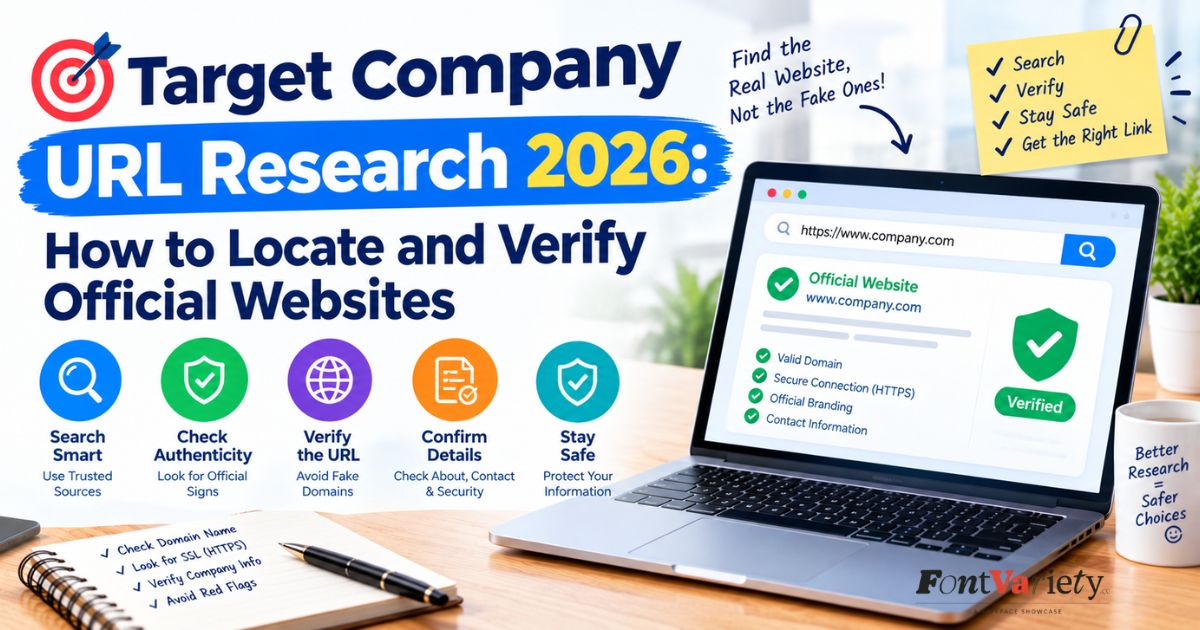
Finding a company’s name is easy. Finding its correct official website is not always as simple, especially when similar business names, outdated listings, and expired domains crowd search results. This is where Target Company URL Research becomes essential for anyone relying on accurate business data.
Whether you’re a sales rep building a prospect list, a marketer running account-based campaigns, or an analyst mapping a competitive landscape, a single wrong URL can quietly undermine your entire workflow. This guide breaks down what Target Company URL Research actually involves, why it matters, and how to do it accurately in 2026 covering the manual techniques, verification checks, and tools that make the process reliable at scale.
What Is Target Company URL Research?
Target Company URL Research is the process of identifying, confirming, and recording the correct official website for a specific business. It sounds simple, but company names are often shared, misspelled, or attached to multiple domains, making the task more technical than it first appears. Sales teams, marketers, and researchers rely on this process daily to build accurate outreach lists.
At its core, this research combines search techniques, domain analysis, and cross-referencing with trusted business databases. The goal is not just finding a website, but finding the right one that belongs to the exact company being targeted. This distinction matters because acting on the wrong URL can waste time, damage credibility, or send outreach to a competitor.
Modern Target Company URL Research also involves verifying that the domain is still active, owned by the intended company, and not a redirect, parked page, or acquired shell. As businesses merge, rebrand, or shut down, keeping this data current becomes an ongoing responsibility rather than a one-time task.
Why Target Company URL Research Matters for Business
Accurate company URLs are the foundation of almost every outbound business activity, from cold email campaigns to account-based marketing. When a URL is wrong, everything built on top of it—contact records, firmographic data, ad targeting—inherits that error. This single point of failure can quietly damage entire pipelines.
For sales and marketing teams, Target Company URL Research directly affects deliverability, personalization accuracy, and lead scoring. A misidentified domain can lead to emails referencing the wrong products or leadership team, which quickly erodes trust with prospects. This is especially costly in B2B environments where credibility is earned slowly.
Beyond outreach, correct URLs support compliance, competitive analysis, and market mapping. Analysts tracking industry trends need confidence that the data tied to a company actually reflects that company’s real digital presence. Without this accuracy, reports and strategic decisions built on flawed data can mislead entire departments.
How to Perform Target Company URL Research Accurately
Accurate research starts with using multiple identifiers beyond just the company name location, industry, founding year, and known executives all help narrow results. Searching the name alone often returns similarly named companies, franchises, or unrelated brands that share a common word or acronym.
Cross-referencing search engine results with business registries, LinkedIn company pages, and domain WHOIS data adds a verification layer that reduces guesswork. When multiple independent sources point to the same domain, confidence in accuracy increases significantly. This triangulation approach is considered a best practice in professional research workflows.
Finally, documenting the research trail—where the URL was found and how it was verified creates accountability and speeds up future audits. Teams that skip this documentation step often repeat the same research later, wasting time re-verifying data that should have been settled once and recorded properly.
| Step | Action | Purpose |
| 1 | Search company name + location | Narrow down similarly named businesses |
| 2 | Cross-check LinkedIn/registry | Confirm ownership and legitimacy |
| 3 | Run WHOIS/domain check | Verify domain age and registrant |
| 4 | Record source and date | Enable future audits |
Common Mistakes to Avoid During Company URL Research
One of the most frequent mistakes is relying solely on the first search engine result without checking who actually owns it. Paid ads, directory listings, or similarly named competitors can rank above the real company website, especially for smaller or less SEO-optimized businesses.
Another common error is ignoring domain history. A company may have previously owned a domain that was later sold, leaving outdated backlinks or old citations pointing to an unrelated business. Researchers who skip domain history checks risk attaching stale data to active outreach campaigns.
Failing to account for rebrands, mergers, and regional website variants also causes inaccuracies. Large companies sometimes operate different domains per country or business unit, and treating one as universally correct can misrepresent the target entirely. Careful scoping before research begins helps avoid this pitfall.
Why the First Company URL You Find May Be Wrong
Search engines rank pages by relevance and authority, not by verified ownership, which means the top result isn’t guaranteed to be official. Directory sites, review platforms, or outdated cached pages frequently outrank the company’s actual homepage, especially for newer or niche businesses.
Name collisions are another major factor. Common business names across different industries or countries can cause search engines to blend results, presenting an unrelated company’s site as if it were the target. Without additional context like industry or location, this confusion is easy to miss.
Lastly, SEO manipulation or expired-domain squatting can place misleading pages at the top of search results. Some domains are purchased specifically to capture traffic intended for a well-known business name, making surface-level searching an unreliable standalone method.
Also Like To Read This: SparkPressFusion.com Review 2026: Features, Benefits, Pricing & More
How to Find the Right Target Company URL
Start with specific, layered search queries that combine the company name with distinguishing details such as city, industry, or a known product. This reduces the chance of pulling results from unrelated companies that happen to share a name or similar branding.
Business intelligence platforms and official registries, such as government business filings or Chamber of Commerce listings, often provide verified domain information. These sources are generally more reliable than open web search because they require some form of business registration to be listed.
Social proof also helps confirm accuracy checking whether the domain matches the website linked on the company’s verified LinkedIn, Crunchbase, or press release pages adds another layer of confidence. When these sources align, the likelihood of having the correct URL increases substantially.
How to Verify a Company URL
Verification begins with checking the domain’s WHOIS registration details, when publicly available, to see registrant information, creation date, and hosting history. A domain registered decades ago with consistent ownership is generally more trustworthy than one created recently under anonymous privacy protection.
Reviewing on-site content is equally important confirming that the address, leadership names, and product descriptions match what’s expected for the target company. Inconsistent or generic content can indicate a placeholder page, a defunct business, or an unrelated site entirely.
Technical signals like SSL certificates, consistent branding across subpages, and matching contact information (phone, email domain) provide additional confirmation. When these technical and content-based checks align, the URL can be marked as verified with a high degree of confidence.
| Verification Check | What to Look For |
| WHOIS data | Registrant name, domain age |
| On-site content | Matching leadership, address, products |
| Email domain match | Same domain used in official contact emails |
| SSL and branding | Consistent security and visual identity |
A Simple Right-Company Test
A quick right-company test involves checking three data points at once: the company name, physical address, and at least one named employee or executive. If all three align between the search result and the website content, the odds of having the correct company jump significantly.
Another useful test is comparing the website’s “About Us” or “Contact” page against any known public filings or press mentions. Discrepancies in founding date, headquarters location, or industry description are red flags that the domain may belong to a different or outdated entity.
Finally, checking whether the domain is referenced consistently across multiple independent platforms social media, press coverage, and business directories—serves as a final sanity check. Agreement across unrelated sources is one of the strongest indicators of a verified, correct company URL.
Why Is Target Company URL Research Important?
Beyond individual outreach accuracy, this research protects brand reputation by ensuring communications, partnerships, and data enrichment tools reference legitimate businesses. Mistakes at this stage can cascade into CRM systems, automated workflows, and reporting dashboards used across an organization.
It also supports due diligence in partnerships, vendor selection, and investment research, where confirming a company’s real digital footprint is a baseline requirement. Decision-makers rely on this verified information before committing resources or signing agreements.
In competitive and market analysis, accurate URLs ensure that tracked metrics traffic estimates, technology stacks, hiring trends are attributed to the correct business. Misattributed data can distort competitive positioning and lead strategy teams toward flawed conclusions.
Target Company URL Research Process
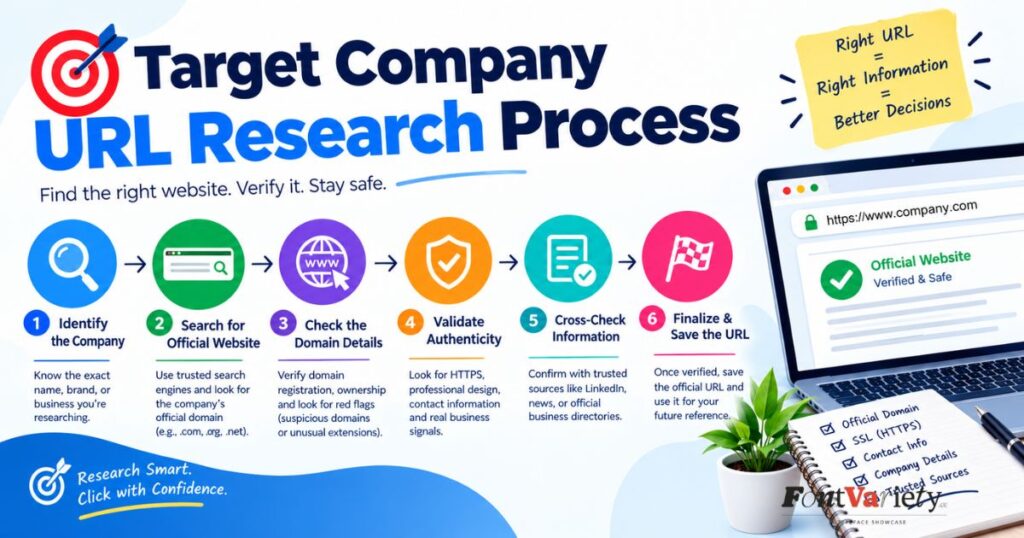
The process typically begins with defining clear search parameters: company name, industry, region, and any known identifiers like a stock ticker or registration number. This initial scoping step significantly narrows the field of potential matches before any searching begins.
Next comes the search-and-collect phase, where researchers gather candidate URLs from search engines, directories, and business databases. Each candidate is logged along with the source it came from, creating a working shortlist rather than committing to a single guess immediately.
The final phase is verification and documentation, where each shortlisted URL is checked against the criteria discussed earlier—ownership, content match, and cross-source agreement. Once confirmed, the URL is recorded in the company’s record along with the verification date for future reference.
How Does Target Company URL Research Work?
At a technical level, this research works by combining structured data sources (business registries, firmographic databases) with unstructured sources (search engines, social media) to triangulate a single accurate answer. Neither source type alone is usually sufficient for full confidence.
Automated tools often use APIs that query multiple databases simultaneously, scoring potential matches based on name similarity, location, and metadata overlap. This scoring system helps prioritize the most likely correct URL when multiple candidates exist for a similar company name.
Human review remains an important final layer, especially for ambiguous cases involving similarly named companies or recent rebrands. Even the best automated systems benefit from a manual check when confidence scores fall below a reliable threshold.
Target Company URL Research for B2B Sales
In B2B sales, accurate company URLs directly influence prospecting quality, since most enrichment tools use the domain as the primary key to pull firmographic and contact data. A wrong URL means incorrect employee counts, revenue estimates, and technology stack information attached to a lead.
Sales development representatives use verified URLs to personalize outreach, referencing accurate company details that demonstrate genuine research rather than generic templates. This personalization has a measurable impact on response rates and overall campaign performance.
Account-based marketing strategies depend even more heavily on this accuracy, since entire campaigns are built around a target account list. If the underlying URLs are wrong, ad targeting, content personalization, and reporting all become misaligned with the intended audience.
Target Company URL Research for Market Research
Market researchers use verified company URLs to build accurate competitive landscapes, ensuring that traffic, technology, and hiring data reflect the actual businesses being studied. This is particularly important when comparing companies across regions with similar naming conventions.
Industry reports and market sizing studies often aggregate data scraped from company websites, meaning any URL inaccuracies directly distort the resulting statistics. A single misattributed company can skew percentages in smaller or niche market segments significantly.
Researchers also use this process to track company lifecycle events rebrands, mergers, or shutdowns by monitoring changes in domain ownership and website content over time. This ongoing monitoring turns a one-time research task into a valuable, continuously updated market intelligence asset.
Manual vs. Automated Company URL Research
Manual research offers higher accuracy for complex or ambiguous cases, since human judgment can weigh context, industry knowledge, and subtle signals that automated systems might miss. However, this approach scales poorly when hundreds or thousands of companies need verification.
Automated research, using APIs and enrichment platforms, handles volume efficiently and can process large lists in a fraction of the time manual research would take. The trade-off is a reliance on algorithmic matching, which can misfire on companies with common names or limited public data.
A hybrid approach—automating the bulk of the work and manually reviewing low-confidence matches—tends to offer the best balance of speed and accuracy. This method is increasingly standard among data teams handling large-scale company research projects.
| Approach | Speed | Accuracy | Best Use Case |
| Manual | Slow | High | Small lists, ambiguous cases |
| Automated | Fast | Moderate | Large-scale bulk research |
| Hybrid | Balanced | High | Enterprise data pipelines |
Target Company URL Research for Sales, Marketing, and SEO
For sales teams, verified URLs anchor CRM records and prevent duplicate or mismatched contact data from entering the pipeline. Clean domain data also improves email deliverability by ensuring outreach aligns with legitimate business email domains rather than personal or unrelated addresses.
Marketing teams rely on accurate URLs for programmatic advertising, retargeting, and content syndication aimed at specific accounts. Incorrect domain data can cause ad spend to be wasted on the wrong audience or, worse, on a direct competitor’s website visitors.
SEO professionals use Target Company URL Research when conducting competitor analysis or backlink audits, ensuring that tracked domains genuinely belong to the intended competitors. Misidentifying a competitor’s domain can lead to flawed keyword strategies and misdirected content planning.
Using Target Company URL Research Tools Effectively
Effective tool usage starts with understanding each platform’s data sources and update frequency, since some databases refresh in real time while others lag behind by months. Knowing this helps set realistic expectations for data freshness during time-sensitive campaigns.
Combining tool output with manual spot-checks, especially for high-value accounts, prevents over-reliance on automated confidence scores alone. Even well-regarded platforms occasionally return outdated or incorrect URLs, particularly for smaller or newly formed companies.
Setting up periodic re-verification workflows ensures that previously confirmed URLs remain accurate over time, since companies do rebrand, merge, or change domains. Treating verification as an ongoing process rather than a one-time task keeps the underlying data reliable long-term.
How to Build a Reliable Company URL Database
Building a reliable database starts with standardizing data fields company name, verified URL, verification date, and source—so records remain consistent and easy to audit later. This structure also makes it easier to spot outdated entries that need re-verification.
Integrating automated enrichment tools with scheduled manual reviews creates a sustainable maintenance workflow rather than a one-time cleanup effort. Assigning ownership of this process to a specific team or role helps ensure consistency as the database grows.
Finally, building in change-tracking—logging when a URL is updated and why creates an audit trail that proves valuable during compliance checks or when investigating data discrepancies. Over time, this disciplined approach turns a simple list of URLs into a genuinely trustworthy business asset.
FAQ’s
What is Target Company URL Research?
It’s the process of finding and confirming the correct, official website for a specific business, rather than relying on the first search result or an assumed domain name.
Why does the first search result sometimes show the wrong company?
Search engines rank by relevance and authority, not verified ownership, so directories, competitors with similar names, or outdated pages can outrank the real official site.
How can I verify a company URL is correct?
Cross-check the domain against WHOIS data, on-site content (address, leadership, products), matching email domains, and consistency across LinkedIn, press mentions, and business registries.
Should I use manual or automated research methods?
A hybrid approach works best for most teams: automate bulk lookups for speed, then manually review low-confidence or ambiguous matches for accuracy.
How often should company URL data be re-verified?
Periodically companies rebrand, merge, or change domains over time, so treating verification as an ongoing process rather than a one-time task keeps data reliable.
Why does this research matter for sales and marketing teams?
Accurate URLs are the key that unlocks correct firmographic data, personalization, and ad targeting; a wrong domain can misdirect entire outreach or campaign efforts.
Conclusion
Target Company URL Research isn’t just a small data-entry task it’s a foundational step that determines the accuracy of everything built on top of it, from sales outreach to market analysis. As shown throughout this guide, the first URL you find is often not the right one, which is why layered searching, cross-source verification, and ongoing maintenance are essential rather than optional.
Whether you rely on manual checks, automated tools, or a hybrid of both, the goal remains the same: confirm that the domain you’re using genuinely belongs to the company you’re targeting. Investing time in getting this right in 2026 pays off across every downstream activity—sales, marketing, SEO, and market research alike—by keeping your data, and your decisions, grounded in accurate information.