

If you searched for Software HCS 411GITS, you have probably seen pages describing it as a modular system with new features and a recent update. Most of those pages share the same vague claims and never point to a developer, a changelog, or an official download. That makes it hard to know what is true and what is filler.
This guide separates verified facts from guesswork. You will learn what the name may actually refer to, why the word “updated” needs careful reading, and how to handle errors and downloads without putting your system at risk. We also explain the possible link to Highway Capacity Software, which is a real and well-documented product.
Beyond the name itself, the article covers the engineering practices behind any well-built system: requirements, architecture, testing, databases, and maintenance. These sections are useful whether you are evaluating HCS 411GITS or improving software of your own. Read on for a practical, evidence-based overview.
What Is Software HCS 411GITS?
Software HCS 411GITS is a name that appears in search results and on some blogs, usually described as a modular software system for data handling, processing, and workflow management. However, no official documentation, vendor page, or trusted repository clearly defines it. That gap matters, so readers should approach the name with care.
Many pages that mention it repeat the same general claims without naming a developer, a version history, or a download source. This is common with obscure identifiers that circulate through automated or low-quality content. The name may refer to an internal tool, a mislabeled file, or simply a keyword that gained traffic.
This guide explains what can reasonably be said about Software HCS 411GITS and what cannot. It also covers safe troubleshooting and the engineering practices that would apply to any system of this kind. The goal is to help you make informed decisions rather than trust unverified claims.
Is HCS 411GITS an Official HCS Product?
There is currently no reliable evidence that HCS 411GITS is an official product of any recognized software company. The best-known “HCS” in the engineering world is the Highway Capacity Software from McTrans, and its official releases use clear version naming. The “411GITS” label does not match any published release that we can verify.
Similar-sounding names often come from internal project codes, asset tags, or file identifiers. A string like “411GITS” could easily be one of these, which are meaningful only inside a single organization. Search engines then pick up the fragment, and content sites build articles around it.
Before treating it as a real product, check the publisher’s official website, release notes, and support channels. If none of them mention it, assume it is unverified. This simple check protects you from fake installers, misleading guides, and unnecessary security risk.
What Does “Software HCS 411GITS Updated” Mean?
The phrase “Software HCS 411GITS updated” suggests a newer version with improvements, but no verified changelog supports this. Real updates come with version numbers, dates, and documented fixes. Without those, the word “updated” is a marketing phrase rather than a fact.
On some sites, “updated” simply reflects a page refresh date, not a software release. Publishers often add the word to titles to look current in search results. The software itself, if it exists, may not have changed at all.
If you see this phrase on a download page, treat it with suspicion. A legitimate update is always announced through the vendor’s own channels and can be verified there. When it cannot be, skip the download and look for the official source.
How HCS 411GITS Software Built: What Can Actually Be Said?
Since no official build documentation exists, we cannot describe how this specific software was built. What we can do is outline how systems of this type are typically developed. These stages are standard practice across the industry and give you a useful reference point.
Any claim about the internal design of HCS 411GITS should be read as general, not specific. Beware of articles that describe exact modules, code structures, or algorithms without citing a source. Such details are usually invented to fill space.
The five stages below show what a well-built system would normally include. You can use them as a checklist when evaluating any unfamiliar software, including this one.
1. Requirements and system design
Every reliable software project begins by defining what the system must do and for whom. Teams interview users, list required features, and set limits on performance, cost, and time. This early work prevents expensive changes later in development.
Design then turns those requirements into a plan covering data flow, interfaces, and technology choices. Clear documents from this phase make the software easier to test and maintain. If a product cannot show any such documentation, its reliability is hard to judge.
2. Modular architecture
Modular architecture splits a system into independent parts, such as input handling, processing, storage, and reporting. Each module has a defined job and communicates with others through clear interfaces. This makes the system easier to update without breaking unrelated features.
Modularity also helps teams work in parallel and replace outdated components over time. Many modern systems use this approach because it supports growth and reduces risk. A description of any software that lacks this structure should raise questions.
3. Data and processing layers
Most business software separates its data layer from its processing layer. The data layer stores and retrieves information, while the processing layer applies rules, calculations, or transformations. Keeping them apart improves speed, accuracy, and security.
This separation also makes it easier to add validation and logging at each step. When errors occur, developers can trace them to the exact layer responsible. Well-designed systems document these layers so administrators know where problems originate.
4. Testing
Testing confirms that each part of the software works alone and together. Teams run unit tests, integration tests, and user acceptance tests before any release. Automated testing catches many bugs before users ever see them.
Testing should continue after launch, since real-world use exposes issues that labs miss. Regression tests confirm that new updates do not break older features. Software without a visible testing culture usually shows it through frequent crashes.
5. Deployment and maintenance
Deployment moves the tested software into a live environment, often in stages to limit risk. Good teams prepare rollback plans in case a release causes problems. They also document installation steps so others can repeat them reliably.
Maintenance begins the moment the software goes live. It includes bug fixes, security patches, performance tuning, and user support. A product with no maintenance record is a warning sign, because unpatched software becomes a security risk quickly.
How to Improve Software HCS 411GITS
If you are working with a system labeled HCS 411GITS inside your own organization, improvement starts with understanding what it actually does. Identify the owner, the purpose, and the data it touches. Without that clarity, any change is guesswork.
Improvements should be measured against clear goals such as faster processing, fewer errors, or easier upkeep. Set a baseline first so you can prove that changes helped. Small, tested changes are safer than large rewrites.
The four areas below cover the most common improvement targets. Each applies to almost any business software, regardless of its name or origin.
Improve performance
Start by measuring where time is spent, using profiling tools and log analysis. Slow database queries, unnecessary network calls, and inefficient loops are frequent culprits. Fix the largest bottleneck first, since it usually delivers the biggest gain.
Caching, indexing, and batch processing can reduce load significantly. Retest after every change to confirm that speed improved without introducing bugs. Keep records of results so future teams understand what worked.
Improve reliability
Reliability means the system works correctly and predictably over time. Add health checks, automatic restarts, and clear error handling so failures do not spread. Backups and tested recovery plans protect your data when something goes wrong.
Monitoring tools should alert you before users notice a problem. Track uptime, error rates, and response times as core metrics. Regular review of these numbers reveals slow declines that would otherwise go unseen.
Improve maintainability
Maintainable software is easy to read, change, and hand over to new people. Use consistent naming, clear comments, and up-to-date documentation. Remove dead code and duplicated logic, which make every change riskier.
Version control and code reviews keep changes organized and accountable. Automated tests give developers confidence to modify code safely. Over time, these habits cut the cost of ownership dramatically.
Improve security
Keep the system and all dependencies patched, since known vulnerabilities are the easiest attack route. Apply least-privilege access so users and services only reach what they need. Encrypt sensitive data both in storage and in transit.
Log important actions and review those logs regularly to detect unusual behavior. Conduct periodic security assessments, especially after major changes. Never install software from unverified sources, as this is a common way malware enters systems.
HCS 411GITS Error Codes: What Should You Believe?
Some websites list specific error codes for HCS 411GITS along with detailed fixes. Since the software itself is unverified, these lists should not be trusted. Error codes are defined by the software’s developer, and no official code reference exists here.
Many such lists are generated to attract search traffic and may contain invented codes. Following their instructions could lead you to delete files or change settings unnecessarily. In the worst cases, they push readers toward fake “repair” downloads.
The safest approach is to treat any error message as a clue rather than a diagnosis. Note its exact wording, the program that produced it, and what you were doing at the time. That information is far more valuable than an unverified code list.
What to do when you see an HCS 411GITS error
First, identify which application actually displayed the message, because the same text can appear in unrelated programs. Take a screenshot and copy the exact wording. Check whether the issue happens every time or only in certain situations.
Next, contact the vendor or your IT administrator with those details. If the software came from an official source, its support team can interpret the message correctly. Avoid downloading “fix” tools from third-party sites, as these often cause more harm than the original error.
Software Development Lifecycle for HCS 411gits Improvement
The software development lifecycle, or SDLC, is a structured process that guides a project from idea to retirement. Its usual phases are planning, analysis, design, development, testing, deployment, and maintenance. Applying it to HCS 411gits improvement brings order to what might otherwise be scattered fixes.
Using an SDLC also creates a paper trail of decisions, which is valuable when systems are poorly documented. Teams can see why changes were made and what results followed. This visibility reduces repeated mistakes and speeds up onboarding.
Different models suit different needs. Agile works well when requirements change often, while waterfall fits projects with fixed scope. Choose the model that matches your team, and adapt it rather than following it rigidly.
How to Improve Software HCS 411gits Through Requirements Gathering
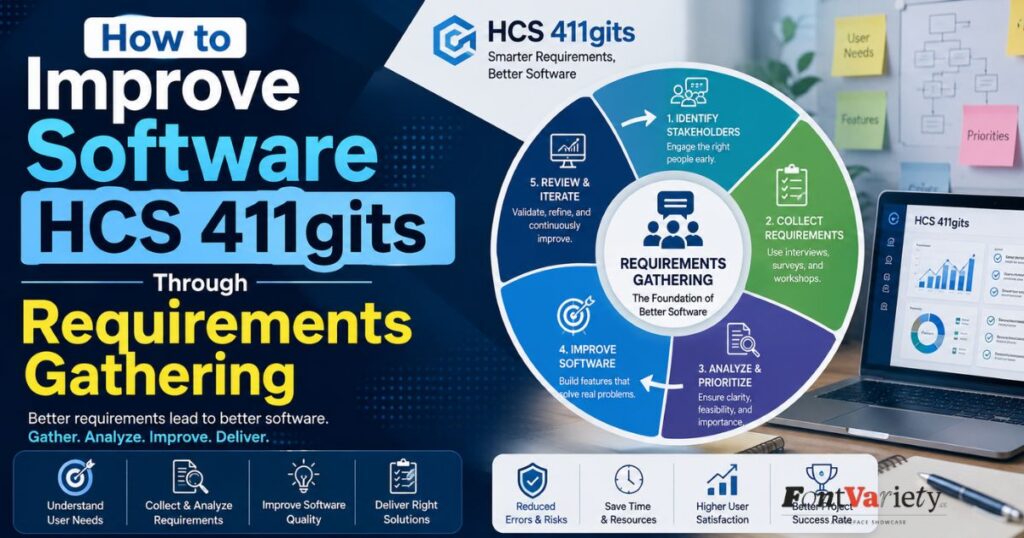
Requirements gathering is the most effective way to improve any system because it ensures you solve the right problem. Talk to the people who use the software daily, not just managers. Their frustrations and workarounds reveal what truly needs fixing.
Write requirements in clear, testable language, such as “reports must load within five seconds.” Vague goals like “make it faster” cannot be verified. Prioritize each requirement by business value and effort so the team focuses on what matters most.
Review the requirements regularly as needs evolve. Involve stakeholders in each review to prevent surprises at delivery time. A well-maintained requirements list becomes the foundation for design, testing, and acceptance.
Architecture Design for Scalable HCS 411gits Systems
Scalable architecture allows a system to handle more users and data without a drop in quality. Designers plan for growth by separating components and avoiding single points of failure. This planning is far cheaper than rebuilding after the system is overloaded.
Common techniques include load balancing, horizontal scaling, and asynchronous processing. Stateless services are easier to duplicate, which supports smooth expansion. Cloud platforms make it simpler to add capacity when demand rises and remove it when it falls.
Document the architecture with diagrams and decision notes. This helps future engineers understand trade-offs and avoid breaking key assumptions. Review the design periodically to confirm it still fits current usage patterns.
Testing Strategies for HCS 411gits
A strong testing strategy combines several levels of checks, from small unit tests to full end-to-end scenarios. Each level catches different problems, so relying on only one leaves gaps. Automation makes running these tests fast and repeatable.
Include performance and load testing to see how the system behaves under stress. Security testing, such as vulnerability scans and penetration tests, identifies weaknesses before attackers do. Usability testing with real people shows problems that automated tools cannot detect.
Integrate testing into your regular workflow through continuous integration. Every code change should trigger automatic tests, with clear reports on failures. This habit keeps quality steady as the system grows and changes.
Also Like To Read This: Immorpos35.3 Software Benefits and Features: A Complete Guide
Common Causes of Software Errors
Software errors rarely appear without a reason, and most fall into a small set of familiar categories. Understanding these categories helps you troubleshoot faster and avoid random guesses. It also shows why many “mystery” errors have simple explanations.
Most causes relate to the environment around the software rather than the code itself. Changes to settings, files, permissions, or connections can all trigger failures. That is why reviewing recent changes is one of the most effective first steps.
The five causes below account for a large share of everyday problems. Checking them in order often resolves an issue without any need for specialist help.
Configuration problems
Configuration errors occur when settings are missing, incorrect, or inconsistent across environments. A wrong file path, an outdated setting, or a mistyped value can stop a program from starting. These mistakes are especially common after migrations or manual edits.
Compare the current configuration with a known good copy or the vendor’s defaults. Keep configuration files under version control so changes are traceable. When possible, use validation tools to catch mistakes before they reach production.
Missing dependencies
Most software relies on libraries, runtimes, or services that must be installed separately. If one is missing or the wrong version is present, errors appear at startup or during specific tasks. Updates to the operating system can also break previously working dependencies.
Review the official requirements list and confirm each item is installed at the right version. Package managers can automate this process and reduce manual mistakes. Document all dependencies so reinstalls and migrations go smoothly.
Corrupted files
Files can become corrupted through interrupted downloads, disk problems, sudden power loss, or malware. A damaged file may cause crashes, strange behavior, or refusal to launch. Sometimes the corruption is small and only shows up in rare situations.
Use the built-in repair options of the software or operating system to check file integrity. Verified checksums help confirm that a download is complete and unaltered. Regular backups let you restore healthy versions quickly.
Permission problems
Software needs the right permissions to read files, write data, and access network resources. If an account lacks these rights, the program may fail without a clear explanation. This often happens after user account changes or security updates.
Check which account runs the software and what access it has. Grant only the permissions required, following the principle of least privilege. Avoid running everything as an administrator, since that creates serious security risks.
Network failures
Applications that depend on servers, databases, or online services will fail when connections break. Causes include unstable internet, firewall rules, DNS issues, and expired certificates. The resulting messages are often vague, which makes diagnosis harder.
Test connectivity with basic tools to see whether the target service is reachable. Review firewall and proxy settings for recent changes. Building in retry logic and clear timeout messages makes software more resilient to temporary outages.
Safe Troubleshooting for HCS 411GITS
Troubleshooting unfamiliar software should always start with caution. Because HCS 411GITS cannot be verified, you should avoid actions that could damage your system or expose your data. A careful, step-by-step approach is safer and often faster than trying random fixes.
Never disable antivirus tools or run unknown executables just because a website says it will fix the problem. Trustworthy solutions come from official vendors, documented procedures, or your organization’s IT team. If a fix requires unusual risk, it is probably not legitimate.
The six steps below form a simple, safe process you can follow. Each one reduces uncertainty and protects your system while you look for the real cause.
Step 1: Identify the software
Confirm exactly which program, file, or service is involved. Check the application name, version, publisher, and file location. Right-clicking the file and viewing its properties often reveals useful details.
If you cannot identify a legitimate publisher, treat the software as suspicious. Scan it with a trusted security tool before doing anything else. Knowing what you are dealing with prevents wasted effort and avoidable risk.
Step 2: Save the error
Record the full error message, including any codes, timestamps, and file names. Take a screenshot so the exact wording is preserved. Note what you were doing right before the problem appeared.
This record helps support teams diagnose the issue quickly. It also lets you compare future errors to see whether the problem is recurring. Even small details can point to the underlying cause.
Step 3: Check recent changes
Think about what changed before the problem began, such as updates, new installations, or settings changes. Many errors are triggered by a single recent modification. Reviewing update history often reveals the cause immediately.
If a recent change looks suspicious, undo it carefully and test again. Use system restore points or version control where available. Documenting each change you make keeps troubleshooting organized.
Step 4: Restart
A simple restart clears temporary states, frees memory, and reloads services. It resolves a surprising number of glitches and takes only a moment. Restart the application first, then the device if needed.
If the problem disappears, monitor for a repeat, since it may return. Recurring issues after restarts suggest a deeper cause worth investigating. Note the pattern for later analysis.
Step 5: Use official repair options
Many applications include built-in repair, reset, or diagnostic tools. Operating systems also offer file checkers and update troubleshooters. These are safer than third-party utilities because they come from trusted sources.
Follow the vendor’s documented repair steps exactly. Back up important data before running repairs, just in case. If official tools do not help, contact support instead of trying unverified downloads.
Step 6: Reinstall only from a trusted source
If repair fails, a clean reinstall may help, but only from the vendor’s official site or your organization’s approved software portal. Avoid mirror sites, forums, and file-sharing links. Unofficial installers are a leading source of malware.
Remove old files and settings as recommended by the vendor before reinstalling. Verify the download with checksums when they are provided. After installation, apply all official updates before restoring your data.
What If You Actually Mean Highway Capacity Software?
Many people searching “HCS” are actually looking for Highway Capacity Software, a well-known traffic analysis tool used by transportation engineers. It implements the methods from the Highway Capacity Manual and is developed and distributed through McTrans at the University of Florida. This is a real, documented product with official support.
If your work involves traffic flow, intersections, freeways, or road design, this is very likely what you need. The software analyzes capacity, delay, and level of service for different roadway types. Engineers, planners, and students use it widely.
To get it safely, visit the official McTrans website and follow their licensing and download instructions. Avoid third-party sites offering “cracked” or renamed versions. Official channels also provide updates, manuals, and training resources.
HCS 2026 vs the Unverified “411GITS” Name
The difference between the two is mainly about verification. Highway Capacity Software has a documented publisher, version history, and support system, so you can confirm what a release contains. The “411GITS” name has none of these, which makes any claim about it uncertain.
When comparing them, ask a few simple questions: Who publishes it? Where is the official download? Is there a changelog and support contact? A legitimate product answers all three, while an unverified one usually cannot.
If you need dependable results, especially for professional or regulated work, choose the verified option. Check the official site for the latest release details before making decisions, since version information changes over time. Trust should come from evidence, not from a keyword appearing in search results.
Should You Download HCS 411GITS?
In most cases, the answer is no, at least not without verification. With no confirmed publisher or official page, any file offering this name could be unsafe. Fake installers are a well-known way to spread malware, adware, and credential-stealing tools.
If your employer or a colleague gave you the software, confirm its origin with them first. Ask for the source, version, and purpose in writing. Your IT department can scan the file and approve it if it is legitimate.
If you must test it, do so in an isolated environment such as a virtual machine, with no sensitive data present. Keep security software active and monitor its behavior. When in doubt, do not install it, and look for a verified alternative instead.
In step four inner system logic and backend
The fourth stage of many development processes focuses on the inner system logic and backend. This is where the rules, calculations, and workflows that power the software are actually built. Clean, well-structured logic here determines how accurate and maintainable the whole system will be.
Backend design also covers how the system handles requests, authentication, and communication between services. APIs define these interactions clearly, so front-end tools and other systems can connect reliably. Careful input validation prevents many errors and security flaws.
Good backend work includes logging, error handling, and documentation. These features make problems visible and fixable when the system runs in production. Investing in this layer pays off through fewer outages and faster development later.
Designing the database and managing data
Database design shapes how information is stored, related, and retrieved. A good design uses clear tables or collections, sensible relationships, and indexes for common queries. Planning this early avoids painful restructuring after the system holds large amounts of data.
Data management goes beyond storage. It includes backups, retention rules, access controls, and quality checks. Consistent naming and validation rules keep data clean and trustworthy over time.
Regular performance reviews help spot slow queries and growing tables. Archive or remove outdated records according to policy and legal requirements. Strong data practices support reporting, security, and compliance across the entire system.
Maintenance and improvementContinued use of performance metrics, regular monitoring and review
Maintenance is an ongoing responsibility, not a one-time task. After release, teams must fix bugs, apply security patches, and adapt the software to changing needs. Ignoring maintenance allows small issues to grow into major failures.
Performance metrics guide these efforts with real evidence. Track response times, error rates, resource usage, and user satisfaction on a regular schedule. Dashboards and alerts make trends visible before they affect users.
Regular reviews turn data into action. Hold periodic meetings to discuss metrics, incidents, and improvement ideas, and assign clear owners to each task. This cycle of monitoring and refinement keeps software healthy for years.
Future Improvements in Software Development
Software development continues to change quickly, and several trends will shape future systems. Artificial intelligence is already assisting with code generation, testing, and bug detection. Teams that use these tools carefully can work faster while keeping human oversight in place.
Cloud-native design, automation, and DevSecOps practices are also becoming standard. They allow faster releases, built-in security checks, and easier scaling. Low-code platforms and better observability tools further reduce the barriers to building reliable systems.
Whatever tools emerge, the fundamentals stay the same: clear requirements, sound architecture, thorough testing, and honest verification. For names like HCS 411GITS, that means confirming what a product is before relying on it. Careful, evidence-based choices will always outperform hype.
Frequently Asked Questions
What is Software HCS 411GITS?
Software HCS 411GITS is a name used online for a supposed modular system that handles data and workflows. No official vendor, documentation, or trusted repository confirms it. It may be an internal project code, a mislabeled file, or a keyword that gained search traffic.
Is Software HCS 411GITS safe to download?
It cannot be considered safe without verification. With no confirmed publisher or official download page, any file using this name could carry malware or adware. Only install it if your employer or IT team confirms the source and scans the file first.
Is HCS 411GITS the same as Highway Capacity Software?
There is no evidence that they are the same. Highway Capacity Software is a real traffic analysis product from McTrans at the University of Florida, with official releases and support. If you work in traffic engineering, that is most likely the tool you need.
Does “Software HCS 411GITS updated” mean there is a new version?
Not necessarily. No verified changelog or release notes support the claim. On many sites, “updated” only reflects a page refresh date, so always check the vendor’s official channels for real version information.
How do I fix an HCS 411GITS error?
Identify which application showed the message, save the exact wording, and check what changed recently. Then restart, use official repair options, and contact your IT team or vendor if the problem continues. Avoid third-party “fix” tools, since they often cause more harm than the error.
What are the most common causes of software errors?
Most errors come from configuration problems, missing dependencies, corrupted files, permission issues, or network failures. Checking these five areas in order resolves a large share of everyday problems. Reviewing recent updates or settings changes is often the fastest first step.
How can I improve software like HCS 411GITS?
Start with clear requirements gathered from real users, then set measurable goals for performance, reliability, maintainability, and security. Follow a structured lifecycle, test at every level, and monitor metrics after release. Small, tested changes are safer than large rewrites.
Conclusion
Software HCS 411GITS remains an unverified name. No official publisher, version history, or trusted download source confirms what it is, so claims about its features, updates, or error codes should be treated with caution. The safest approach is to verify first and act second.
If you need a dependable HCS tool, especially for traffic analysis, Highway Capacity Software from McTrans is the documented option. For any unfamiliar software, confirm the publisher, check for a changelog, and download only from official channels. Following the safe troubleshooting steps in this guide protects both your system and your data.
The engineering practices covered here apply well beyond this one name. Clear requirements, scalable architecture, thorough testing, careful data management, and steady maintenance are what make any system reliable. Choose evidence over hype, and your software decisions will hold up over time.