

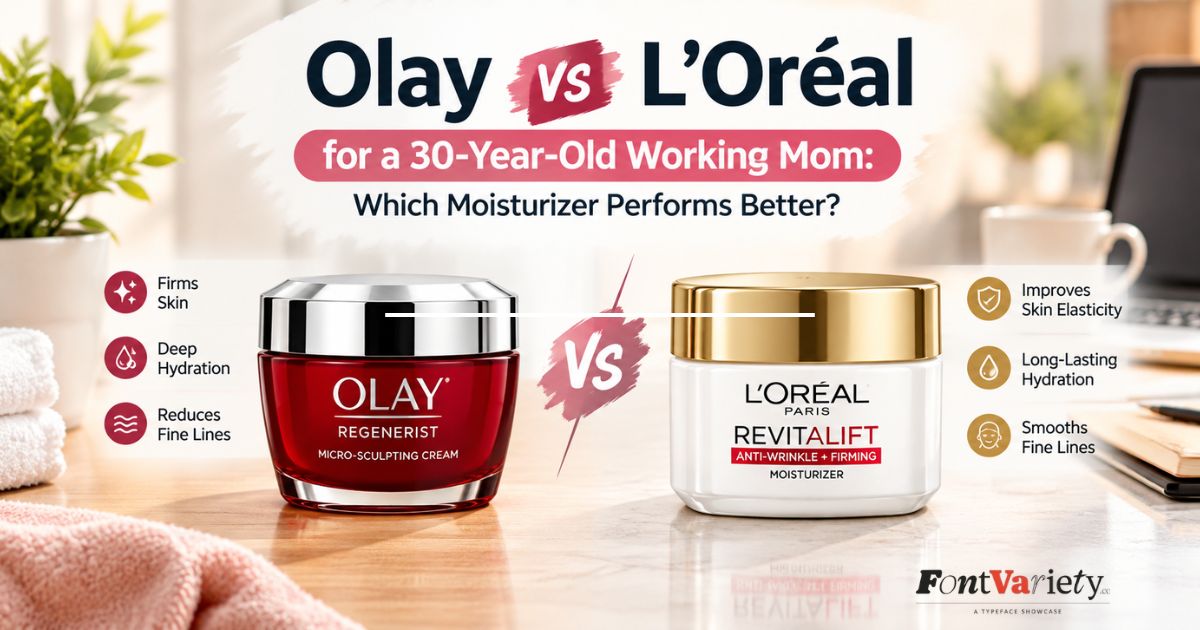
Choosing between Olay vs L’Oréal can feel overwhelming when you’re standing in the skincare aisle with five minutes to spare before school pickup. Both brands are drugstore staples, both promise anti-aging benefits, and both claim to hydrate better than the competition but their actual formulas, price points, and routines differ more than the packaging suggests.
For a 30-year-old working mom, the stakes aren’t about chasing the latest 10-step K-beauty routine. It’s about finding a moisturizer that actually fits into a rushed morning, works with tired, stressed-out skin, and doesn’t blow the household budget. Olay and L’Oréal each solve that problem differently one through simplicity, the other through targeted treatment.
This guide breaks down exactly where each brand excels, where it falls short, and which one makes more sense depending on your skin concerns, schedule, and budget. By the end, you’ll know whether Olay’s grab-and-go moisturizers or L’Oréal’s treatment-style routine is the better fit for your specific situation.
Olay vs L’Oréal Skincare: Quick Comparison
When it comes to Olay vs L’Oréal, the two brands take noticeably different approaches to skincare. Olay leans into simple, budget-friendly moisturizers built around a handful of proven ingredients like niacinamide and peptides. L’Oréal, on the other hand, offers a wider mix of serums, treatments, and moisturizers pulled from its dermatology-backed Revitalift and Age Perfect lines. For a busy 30-year-old mom short on time, the difference often comes down to simplicity versus routine depth.
Both brands are drugstore-accessible and widely available, which makes them realistic options for anyone not ready to invest in prestige skincare. Olay tends to win on ease of use and price-per-jar, while L’Oréal tends to win on ingredient variety and targeted treatments. Neither is objectively “better” across the board it depends on whether you want a one-step moisturizer or a multi-step routine.
Below is a quick snapshot before we break down each category in detail.
| Category | Olay | L’Oréal |
| Best for | Simplicity, daily hydration | Targeted treatment routines |
| Price range | 15–30 | 13–45 |
| Key ingredients | Niacinamide, peptides, hyaluronic acid | Retinol, vitamin C, hyaluronic acid |
| Routine complexity | Low (1–2 steps) | Medium-high (2–4 steps) |
| Best suited for | Busy moms wanting speed | Moms wanting visible anti-aging results |
Olay vs L’Oréal Skincare: What’s the Main Difference?
The core distinction in Olay vs L’Oréal comes down to formulation philosophy. Olay builds most of its moisturizers around a compact list of dermatologist-recognized actives, keeping formulas straightforward and multi-purpose. L’Oréal instead structures its skincare as a layered system, encouraging users to combine a serum, moisturizer, and sometimes an eye cream for full effect.
This difference shows up in how each brand markets itself. Olay’s messaging centers on “one jar does it all,” appealing to people who want fewer decisions in their routine. L’Oréal leans into its Paris dermatology heritage, positioning itself as a more clinical, results-driven option with products designed to target specific concerns like dark spots or deep wrinkles.
Neither approach is wrong, but they suit different lifestyles. A working mom juggling a morning routine in under five minutes will likely gravitate toward Olay’s simplicity, while someone willing to spend a bit more time layering products may prefer L’Oréal’s targeted system.
Olay Focus
Olay’s product philosophy centers on multi-tasking moisturizers that combine hydration with light anti-aging benefits in a single step. Its Regenerist and Total Effects lines are built around ingredients like niacinamide, peptides, and vitamin B3, chosen because they address several concerns dullness, fine lines, uneven tone without requiring a full regimen.
This focus makes Olay a practical pick for anyone prioritizing consistency over complexity. Because the formulas are gentle enough for daily use, they fit easily into a rushed morning routine. The trade-off is that Olay rarely markets high-strength actives like retinol at the concentration levels seen in L’Oréal’s treatment products.
L’Oréal Focus
L’Oréal’s focus is treatment-oriented, built around clinically dosed actives such as retinol, vitamin C, and hyaluronic acid delivered through targeted serums. The brand markets itself on visible, measurable anti-aging results, often referencing dermatologist testing and higher active concentrations than typical drugstore moisturizers.
This approach appeals to people who want a routine that evolves with specific skin goals deep wrinkles, sagging, or stubborn dark spots. It does mean more steps and slightly more label-reading, since L’Oréal’s lineup is broader and more segmented by concern than Olay’s.
Olay vs L’Oréal Skincare: Which Is Better for Busy Moms?
For a 30-year-old working mom, time is often the deciding factor more than ingredients. Olay’s one-step moisturizers are designed to be grabbed and applied in seconds, with no need to layer a separate serum first. That single-step design tends to fit better into a school-drop-off-to-work morning than a multi-product regimen.
L’Oréal can still work for busy schedules, but it usually requires picking one or two products rather than the full suggested routine. A retinol serum at night and a simple moisturizer in the morning is manageable even on a tight schedule, but it does ask for a bit more planning than Olay’s single-jar approach.
In practice, many working moms end up mixing both: an Olay moisturizer for daytime speed, and an L’Oréal night serum for more targeted treatment when there’s a spare few minutes before bed. This hybrid approach lets both brands play to their strengths.
Olay vs L’Oréal Moisturizers: Which Hydrates Better?
Hydration performance between Olay vs L’Oréal moisturizers is fairly close, since both rely on hyaluronic acid and glycerin as core humectants. Olay’s Regenerist line tends to feel richer and more occlusive, which suits drier skin types or colder climates where moisture loss is a bigger concern.
L’Oréal’s moisturizers, particularly in the Hydra Genius and Age Perfect ranges, often use lighter, gel-based textures that absorb faster. This makes them a better fit for combination or oily skin types, or for anyone applying moisturizer under makeup during a workday.
Neither brand clearly outperforms the other on raw hydration; the better choice really depends on skin type and climate. Dry-skinned users often report longer-lasting comfort with Olay, while those with normal-to-oily skin tend to prefer L’Oréal’s lighter finish.
Olay vs L’Oréal Skincare: Which Is Better for Early Signs of Aging?
At 30, most early aging concerns are limited to fine lines, mild dullness, and the first hints of uneven texture not yet deep wrinkles. Olay’s peptide-and-niacinamide formulas are well-suited to this stage, since they’re gentle enough for daily preventive use without the irritation risk that stronger actives can bring.
L’Oréal’s retinol-based products are also effective here, but they’re formulated with more visible, faster results in mind, which can mean a slightly longer adjustment period for first-time retinol users. For someone just starting to notice early aging signs, that extra strength isn’t always necessary yet.
The right choice often comes down to whether you want preventive maintenance or active correction. Olay suits the “keep things as they are” mindset, while L’Oréal suits those who’ve already noticed changes and want to address them directly.
Common Concerns at 30
At this age, the most frequently reported skin concerns include mild fine lines around the eyes, occasional dullness from stress or poor sleep, and early loss of firmness. These are largely maintenance-level issues rather than advanced aging, which is why lighter, preventive formulas often perform just as well as stronger treatment products.
For working moms specifically, sleep deprivation and stress-related dullness tend to be bigger day-to-day complaints than wrinkles themselves. This is where a hydrating, brightening moisturizer whether from Olay or L’Oréal often does more visible good than a heavy-duty anti-aging serum.
Price and Value Comparison: Olay vs. L’Oréal Cost-Per-Ounce Breakdown
Price is often the deciding factor for working moms managing a household budget alongside their own skincare needs. On a cost-per-ounce basis, Olay generally comes out cheaper, especially in its larger jar sizes sold at mass retailers. L’Oréal’s pricing varies more widely, since its lineup spans both affordable moisturizers and pricier serums.
| Product Type | Olay (approx.) | L’Oréal (approx.) |
| Basic moisturizer (1.7 oz) | 18–24 | 16–22 |
| Anti-aging cream (1.7 oz) | 24–30 | 20–28 |
| Retinol/active serum (1 oz) | Limited options | 20–45 |
| Value/bulk jar (2 oz+) | 20–28 | Less common |
Olay’s strength is consistency its pricing stays predictable across most of its core lineup. L’Oréal’s range is wider because it includes both everyday moisturizers and premium serums, so total spend depends heavily on which tier of product you choose.
The True Cost of Olay: Average Retail Pricing and Value Sizes
Olay’s retail pricing typically sits in the 18–30 range for its core moisturizers, with larger value-sized jars often reducing the cost per ounce further. This makes Olay a strong option for anyone buying skincare as part of a regular grocery or pharmacy run rather than a separate beauty purchase.
The brand frequently offers multi-packs and sale bundles at big-box retailers, which can bring the effective price down even more. For a working mom restocking skincare alongside household essentials, this convenience factor often matters as much as the price tag itself.
Because Olay’s formulas are consistent across sizes, there’s little value lost by buying the larger jar the formula doesn’t change, only the quantity. This makes bulk-buying a low-risk way to stretch a skincare budget further.
The True Cost of L’Oréal Skincare: Affordable Actives vs. Premium Serum Prices
L’Oréal’s pricing splits fairly clearly into two tiers. Its everyday moisturizers, like those in the Age Perfect or Hydra Genius lines, are priced comparably to Olay, often between $16 and $28. Its treatment serums, however, particularly retinol and vitamin C formulas, can run considerably higher, sometimes reaching $40 or more.
This tiered pricing means L’Oréal can flex to fit different budgets depending on which product tier you shop. A working mom on a tighter budget can stick to the moisturizer tier and still get solid performance, while someone wanting a dedicated treatment can invest in the serum tier without switching brands entirely.
The trade-off is that getting the “full” L’Oréal experience moisturizer plus serum costs more overall than a single Olay jar. Whether that’s worth it depends on how much value you place on targeted actives versus an all-in-one product.
Long-Term Value for Working Moms: Which Brand Lasts Longer on a Budget?
Long-term value depends on how each product is used, not just its shelf price. Olay’s larger jar sizes and single-step application mean a bottle typically lasts longer per dollar spent, since there’s no separate serum being used up alongside it. This makes Olay a strong pick for a predictable, low-maintenance monthly skincare budget.
L’Oréal’s value shifts depending on whether you’re buying moisturizer alone or moisturizer plus serum. Serums are usually applied in small amounts, so a single bottle can last several months even though the upfront price is higher which can actually make cost-per-use fairly competitive over time.
For a working mom optimizing for the lowest ongoing cost, Olay’s simpler system tends to win. For one prioritizing visible results per dollar spent on actives, L’Oréal’s serum tier often delivers comparable long-term value despite the higher sticker price.
Understanding the Main Structural Difference Between Olay and L’Oréal
Structurally, Olay operates as a mono-brand focused almost entirely on facial moisturizers and a narrow set of adjacent products like cleansers and eye creams. This narrow focus lets it refine a smaller set of formulas rather than spreading across many product categories.
L’Oréal Paris, by contrast, operates as part of a much larger parent company with a far broader skincare, haircare, and cosmetics portfolio. Its skincare line reflects that scale, offering more sub-brands (Revitalift, Age Perfect, Hydra Genius) each targeting a slightly different concern or age group.
This structural difference explains a lot of the practical contrasts between the two: Olay’s simplicity comes from a tighter product range, while L’Oréal’s variety comes from operating more like a portfolio of specialized skincare lines under one name.
Anti-Aging and Wrinkle Reduction: Which Shows Faster Results?
For visible wrinkle reduction, L’Oréal’s retinol-based products tend to show faster measurable change, largely because retinol is one of the most clinically studied anti-aging ingredients available at the drugstore level. Users often report smoother texture within four to six weeks of consistent use.
Olay’s peptide-and-niacinamide formulas work more gradually, focusing on long-term skin barrier support and gentle collagen encouragement rather than fast, visible correction. Results tend to appear over a longer window, often eight to twelve weeks, but with less irritation risk along the way.
For someone at 30 dealing mainly with early, subtle signs of aging, this trade-off between speed and gentleness is worth weighing carefully. Faster results from L’Oréal’s retinol come with a higher chance of initial dryness or sensitivity compared to Olay’s milder approach.
Olay vs L’Oréal Skincare: Which Gives Faster Results?
Speed of results largely mirrors the anti-aging comparison above: L’Oréal’s active-forward serums tend to show change sooner, while Olay’s gentler formulas take a more patient, maintenance-focused approach. This makes L’Oréal the better pick for someone wanting to see a difference within a month.
That said, “faster” doesn’t always mean “better” for every skin type. Sensitive or reactive skin can struggle with retinol’s initial adjustment period, sometimes experiencing redness or flaking before results appear. Olay’s slower, steadier formulas avoid this rough patch entirely.
For a working mom who doesn’t have time to manage skin purging or irritation, Olay’s gradual approach may actually be more practical, even if it takes longer to see visible change. Faster results are only useful if they don’t derail an already tight schedule with extra skin recovery time.
Olay vs L’Oréal Skincare: Which Is Easier to Use?
Ease of use is one of the clearest differentiators in the Olay vs L’Oréal comparison. Olay’s single-jar moisturizers require no layering, no waiting between steps, and no need to research which actives can or can’t be combined. This makes it about as low-effort as skincare can get.
L’Oréal’s routine-based approach asks for more decision-making choosing a serum, waiting for it to absorb, then applying a moisturizer on top. This isn’t difficult, but it does add extra minutes and extra products to keep track of and repurchase.
For someone who values a “no-think” morning routine, Olay is easier to stick with long-term. For someone willing to trade a few extra minutes for more targeted control over their skin concerns, L’Oréal’s added steps aren’t a major barrier.
Why Olay Feels Simpler
Olay’s simplicity comes down to formula design: most of its moisturizers are built to function as a complete step rather than one piece of a larger system. There’s no need to layer a separate treatment product first, which removes a common source of confusion for people newer to skincare routines.
This also reduces the risk of ingredient conflicts, since there’s only one product to think about rather than multiple actives interacting with each other. For a busy mom applying moisturizer in the thirty seconds before leaving the house, that simplicity is often the deciding factor over any specific ingredient claim.
Also Like To Read This: Techlokesh Org: What You Should Know About Its Templates and Editing Guides
Olay vs L’Oréal Skincare: Which Brand Offers More Variety?
L’Oréal clearly offers more variety, with distinct sub-lines targeting different concerns Revitalift for deeper wrinkles, Age Perfect for mature skin, and Hydra Genius for lightweight hydration. This breadth means there’s likely a specific L’Oréal product built for almost any skin concern.
Olay’s variety is narrower but still meaningful, with lines like Regenerist, Total Effects, and Luminous each offering a slightly different focus anti-aging, multi-tasking, or brightening. It’s a smaller menu, but each product tends to be more of a generalist within its category.
For someone who likes having many specific options to choose from, L’Oréal’s range will feel more satisfying. For someone who prefers a shorter, simpler decision process, Olay’s narrower lineup can actually be an advantage rather than a limitation.
Olay vs L’Oréal Skincare: Pros and Cons
Weighing the pros and cons side by side makes the Olay vs L’Oréal decision easier, since each brand’s strengths tend to map directly onto its weaknesses. Olay’s simplicity is a strength for busy routines but a limitation for anyone wanting more targeted, high-strength actives. L’Oréal’s variety and stronger actives are a strength for visible results but a drawback for anyone wanting a low-maintenance routine.
Cost is another area where the two trade off. Olay tends to be more consistently affordable across its lineup, while L’Oréal can be cheaper at the entry level but noticeably pricier once you move into its serum tier. Neither pricing structure is better outright it depends on which tier of product you actually plan to buy.
The pros and cons below break this down further by brand, covering the practical day-to-day trade-offs a 30-year-old working mom is likely to notice first.
Olay Pros
Olay’s biggest strength is convenience a single moisturizer often covers hydration, mild anti-aging, and tone-evening in one step. Its pricing is also consistently affordable, especially in larger jar sizes, making it easy to budget for month after month.
The formulas tend to be gentle, which lowers the risk of irritation for sensitive or first-time skincare users. This makes Olay a low-risk entry point for anyone not wanting to deal with adjustment periods or trial-and-error with stronger actives.
Olay Cons
Olay’s main drawback is a lack of high-strength treatment options, particularly retinol at the concentrations L’Oréal offers. This means visible results for deeper wrinkles or stubborn dark spots may take longer to appear, if they appear at all.
The product range is also narrower, which can feel limiting for someone who wants a highly specific solution for one concern, such as targeted dark spot correction. Olay’s generalist formulas work well for overall maintenance but less well for singular, aggressive treatment goals.
L’Oréal Pros
L’Oréal’s biggest advantage is its range of clinically dosed active ingredients, particularly retinol and vitamin C, which tend to produce more visible anti-aging results faster. Its broader product lineup also means there’s usually a formula built specifically for a given concern.
The brand’s tiered pricing also offers flexibility, letting budget-conscious shoppers stick to basic moisturizers while others invest in premium serums. This range makes L’Oréal adaptable to a wider variety of skin types, budgets, and goals within a single brand.
L’Oréal Cons
The main downside is complexity getting the full benefit of L’Oréal’s system usually means using more than one product, which takes more time and more money. Stronger actives like retinol can also cause initial irritation, which isn’t ideal for someone with limited time to manage skin adjustment periods.
Premium serums can push the overall routine cost noticeably higher than Olay’s single-jar approach. For someone wanting the simplest possible routine, L’Oréal’s broader system can feel like more effort than it’s worth.
Olay vs L’Oréal Skincare: Which Is Better Value?
Value depends heavily on what “value” means to the buyer. If it means lowest cost per ounce for a dependable daily moisturizer, Olay generally wins, thanks to its consistent pricing and larger jar sizes. If it means results per active ingredient, L’Oréal’s serums often justify their higher price with more concentrated, clinically supported formulas.
For a working mom on a tight budget who mainly wants reliable hydration and mild anti-aging support, Olay likely delivers better everyday value. For someone willing to spend a bit more for a noticeably faster, more targeted result, L’Oréal’s treatment tier can be worth the extra cost.
Ultimately, neither brand is the clear value winner in every scenario it comes down to matching the product tier to the actual skin goal, rather than comparing sticker prices alone.
Olay vs L’Oréal Skincare: Which Should a 30-Year-Old Working Mom Choose?
For most 30-year-old working moms, the decision comes down to time versus targeting. If mornings are rushed and simplicity matters most, Olay’s one-step moisturizers are the more realistic long-term choice, since they’re easy to stick with even on the busiest days.
If there’s a specific concern noticeable dark spots, early wrinkles around the eyes, or dullness that a basic moisturizer isn’t addressing L’Oréal’s targeted serums may be worth the extra few minutes and dollars. Many moms find success combining both: Olay for daily maintenance, L’Oréal for occasional targeted treatment.
There’s no universally “correct” answer here, but the practical takeaway is this: choose Olay for consistency and ease, and add L’Oréal into the mix only when a specific concern calls for a more targeted formula.
What Makes L’Oréal’s Skincare Line Different?
L’Oréal’s skincare line stands apart through its emphasis on clinically tested actives at concentrations closer to what’s found in dermatology offices, at a fraction of the price. This positions it between typical drugstore basics and prestige skincare, appealing to shoppers who want stronger results without a premium price tag.
Its sub-brand structure also sets it apart, letting shoppers pick a line Revitalift, Age Perfect, Hydra Genius matched closely to their specific age range or concern, rather than a one-size-fits-all product. This segmentation gives L’Oréal a more “curated routine” feel compared to Olay’s broader, simpler formulas.
Olay vs L’Oréal for Busy Moms
Revisiting the busy-mom angle specifically, the deciding factor usually isn’t which brand is “better” in the abstract, but which one fits into an already packed schedule. Olay’s grab-and-go moisturizers require zero extra thought, which matters when mornings are measured in minutes, not routines.
L’Oréal can still fit a busy schedule, but it usually works best when trimmed down to just one or two products rather than a full four-step routine. A simple pairing one L’Oréal serum at night, one moisturizer in the morning keeps the routine realistic without sacrificing the brand’s stronger actives.
For most working moms, the winning approach isn’t picking one brand exclusively, but using each brand where it performs best: Olay for daily ease, L’Oréal for occasional, more deliberate treatment.
Olay vs L’Oréal: Which Has Better Ingredients?
Ingredient quality is fairly comparable between the two brands, though they emphasize different actives. Olay leans on niacinamide, peptides, and hyaluronic acid ingredients known for being effective yet gentle enough for daily, long-term use without much irritation risk.
L’Oréal leans more heavily on retinol and vitamin C, both well-studied for visible anti-aging and brightening effects, but generally requiring more careful introduction into a routine due to higher irritation potential. Its formulas are often positioned as slightly more “clinical” in strength.
Neither brand has objectively superior ingredients it depends on whether gentleness or potency matters more for a given skin type. Sensitive skin often does better with Olay’s milder actives, while more resilient skin can handle and benefit from L’Oréal’s stronger formulations.
Which Brand Is Better for Women in Their 30s?
For women in their 30s specifically, the ideal skincare focus is usually prevention and mild correction rather than aggressive anti-aging treatment. This slightly favors Olay’s gentler, maintenance-style formulas, since heavy-duty actives aren’t always necessary yet at this stage.
That said, women who are already noticing more defined fine lines or uneven pigmentation may benefit more from L’Oréal’s targeted treatments, which are built to address those exact concerns rather than simply maintain the status quo.
The better brand really depends on where an individual’s skin sits within the “early 30s” range closer to prevention favors Olay, while closer to visible correction favors L’Oréal.
Olay is often better for simple anti-aging moisturizers, while L’Oréal offers a broader treatment-style routine
This distinction captures the core of the entire Olay vs L’Oréal comparison. Olay’s strength lies in accessible, all-in-one moisturizers that quietly support skin health without requiring extra thought or extra products. It’s built for consistency rather than intervention.
L’Oréal’s strength lies in offering a more complete, layered treatment system for people who want to address specific concerns directly, whether that’s deeper wrinkles, pigmentation, or dullness. It asks for more effort but delivers more targeted control in return.
Choosing between them isn’t really about which brand is superior, but about which philosophy simple maintenance or active treatment better matches a person’s current skin goals and available time.
Deep dive: how L’Oréal’s skincare line performs
In practical use, L’Oréal’s Revitalift and Age Perfect lines tend to perform well on texture and brightness within several weeks of consistent use, particularly when a retinol or vitamin C serum is paired with a compatible moisturizer. Many users report smoother skin and reduced dullness as the earliest visible changes.
Where L’Oréal performs less consistently is sensitivity management because several of its treatment products use higher concentrations of actives, first-time users sometimes need a gradual introduction period to avoid dryness or redness, especially when starting retinol for the first time.
Overall, L’Oréal performs strongest for people willing to ease into a routine gradually, rather than expecting immediate, irritation-free results from day one. Patience during the first few weeks tends to pay off in more visible longer-term change.
Which brand is better for dullness?
For dullness specifically, both brands offer solid options, but they approach it differently. Olay’s niacinamide-based formulas help even out tone gradually and support the skin barrier, which indirectly improves radiance over time without any risk of irritation-related dullness rebound.
L’Oréal’s vitamin C-based products tend to target dullness more directly and often show brighter-looking skin faster, since vitamin C is specifically known for boosting radiance and fading uneven pigmentation. The trade-off is that vitamin C formulas can be less stable and slightly more prone to irritation for sensitive skin.
For a quick brightness boost, L’Oréal’s vitamin C options often edge ahead. For steady, low-risk dullness maintenance over time, Olay’s gentler approach is the safer long-term pick.
Frequently Asked Questions
Is Olay or L’Oréal better for anti-aging?
L’Oréal tends to show faster, more visible anti-aging results thanks to higher concentrations of retinol and vitamin C in its treatment serums. Olay’s peptide-and-niacinamide formulas work more gradually, focusing on prevention and skin barrier support rather than fast correction. If you want quick results, L’Oréal wins; if you want gentle, long-term maintenance, Olay is the safer choice.
Which brand is cheaper, Olay or L’Oréal?
Olay is generally more consistently affordable, especially in larger jar sizes, with most core moisturizers priced between $18 and $30. L’Oréal’s basic moisturizers are similarly priced, but its retinol and vitamin C serums can push total cost significantly higher, sometimes above $40 per bottle.
Can I use Olay and L’Oréal products together?
Yes, many people mix both brands without issue for example, an Olay moisturizer during the day and an L’Oréal retinol serum at night. Just introduce new actives like retinol slowly, and avoid layering multiple strong ingredients (like retinol and vitamin C) at the same time to reduce irritation risk.
Which brand is better for sensitive skin?
Olay is generally gentler and better suited to sensitive skin, since its formulas prioritize hydration and mild actives over high-strength ingredients. L’Oréal’s stronger retinol and vitamin C products can cause initial dryness or redness, so sensitive skin types may need to introduce them more slowly.
Does Olay or L’Oréal work faster for dullness?
L’Oréal’s vitamin C-based products typically show brighter, more even-toned skin faster, since vitamin C directly targets dullness and pigmentation. Olay’s niacinamide formulas improve tone more gradually but with less irritation risk along the way.
Is L’Oréal considered a higher-end brand than Olay?
Not exactly both are mass-market drugstore brands, but L’Oréal’s serum tier is priced closer to mid-range skincare, while Olay stays firmly in the budget category across its entire lineup. L’Oréal simply offers a wider price range, from basic to near-premium.
What’s the best routine for a busy working mom?
A simple, realistic routine often works best: an Olay moisturizer for quick daily hydration, plus an L’Oréal retinol or vitamin C serum a few nights a week for targeted treatment. This combines Olay’s convenience with L’Oréal’s more active ingredients, without requiring a full multi-step routine every day.
Conclusion
In the end, the Olay vs L’Oréal decision isn’t about which brand is objectively superior it’s about which one matches your skin goals, schedule, and budget as a 30-year-old working mom. Olay wins on simplicity, affordability, and gentle daily maintenance, making it ideal for anyone who wants reliable results without extra effort or cost.
L’Oréal wins on active ingredient strength and targeted treatment, making it the better pick for anyone already noticing specific concerns like fine lines, dark spots, or dullness that a basic moisturizer isn’t addressing. It asks for a bit more time and a bit more money, but often delivers faster, more visible change.
For most busy moms, the smartest approach isn’t choosing one brand exclusively it’s using Olay for everyday hydration and reaching for L’Oréal when a specific concern calls for something stronger. That combination gets you the convenience of one brand and the results of the other, without overhauling your entire routine.