

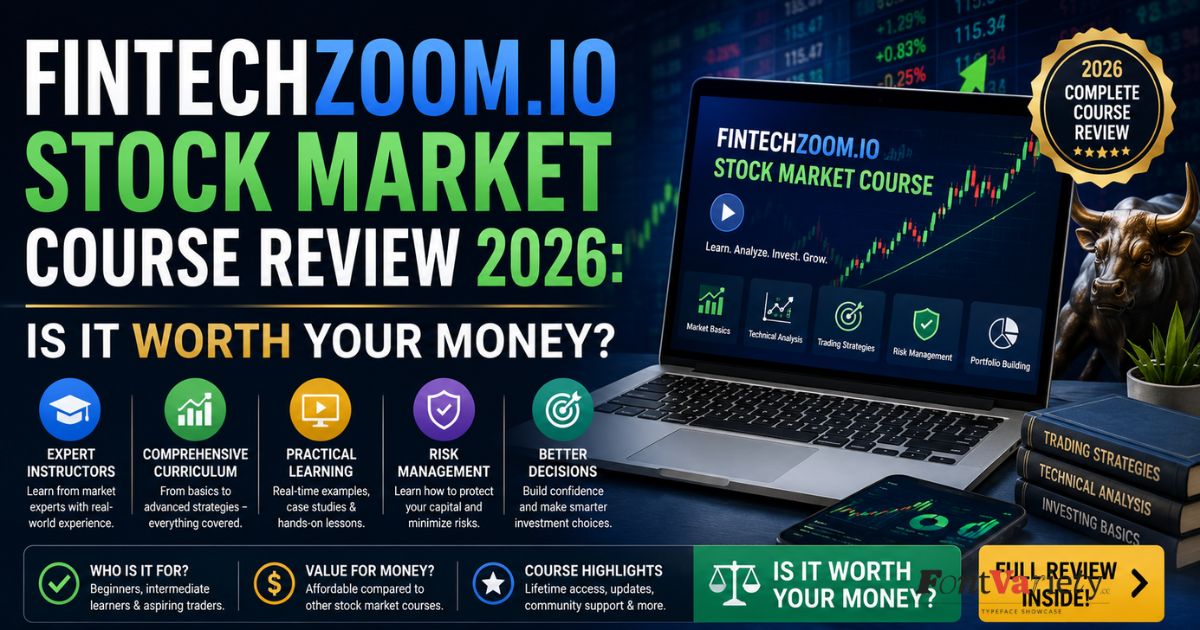
FintechZoom.io has built a reputation as a finance and markets content hub, and its branded stock market course is being marketed to retail investors who want structured education. Before spending money on it, most people want a straight answer on what it actually covers, who runs it, and whether it beats free alternatives.
This review breaks the course down section by section so you can decide with clear eyes.
What Is the FintechZoom.io Stock Market Course?
The FintechZoom.io Stock Market Course is positioned as a structured, self-paced program meant to take a learner from basic market literacy to a working understanding of trading and investing. It’s marketed through the FintechZoom.io site, which is better known for finance news and market commentary than for education products, so the course is essentially a newer offshoot of that brand.
In practice, it’s presented as a bundle of video lessons, reading material, and possibly templates or checklists, aimed at people who want a single place to learn rather than piecing information together from scattered sources. The exact delivery platform, whether hosted natively or through a third-party learning system, isn’t always made obvious on the sales page.
Because FintechZoom.io is primarily a content site rather than an established education provider, it’s worth approaching the course description with a healthy dose of skepticism. Marketing copy tends to oversell scope and outcomes, so the safest approach is to treat public claims as a starting point for your own research, not as verified fact.
What Does the FintechZoom.io Stock Market Course Teach?
Based on how the course is marketed, the curriculum appears to move through the typical arc of retail market education: understanding what stocks and exchanges are, learning to read charts, applying that knowledge to investing decisions, and finally layering in risk management and trading psychology. This is a common structure across most beginner-to-intermediate finance courses.
The appeal of this kind of layout is that it doesn’t assume prior knowledge, which matters if you’re coming in cold. Each stage is meant to build on the last, so a learner who sticks with the whole sequence should end up with both vocabulary and practical technique rather than just theory.
That said, breadth doesn’t guarantee depth. A course that tries to cover fundamentals, technical analysis, investing, and trading psychology in one package risks being shallow in each area unless the lesson count and instructor time are genuinely substantial. This is one of the first things worth checking before you commit.
Stock Market Fundamentals
This section is likely to cover the basics: what stocks represent, how exchanges function, how orders get placed and filled, and the terminology that shows up everywhere else in the course. For true beginners, this is the module that determines whether the rest of the material will actually make sense.
If you already know what a bid-ask spread or a market order is, this section will feel like review rather than new learning. It’s still useful as a baseline check, but it shouldn’t be the reason you buy the course if you’re past the absolute beginner stage.
Technical Analysis and Chart Reading
Technical analysis modules typically walk through candlestick patterns, support and resistance, moving averages, and common indicators like RSI or MACD. The value here depends heavily on whether the instructor explains why these tools work and where they fail, rather than just naming them.
Chart reading is also one of the easiest topics to teach badly, since it’s easy to show winning examples in hindsight without addressing false signals. A course worth paying for should walk through losing setups too, not just cherry-picked chart patterns that look convincing after the fact.
Investing and Portfolio Basics
This section presumably covers longer-horizon concepts: diversification, asset allocation, position sizing, and how to think about building a portfolio rather than picking single trades. It’s the part of the course most relevant to someone investing for retirement or long-term goals rather than active trading.
Good portfolio education should include discussion of fees, tax basics, and realistic return expectations, not just enthusiasm about compounding. If this module skips those practical constraints, it’s missing content that matters more than most stock-picking advice.
Trading, Risk Management and Psychology
Risk management content usually covers position sizing, stop-losses, and how much of an account to risk per trade. Psychology modules tend to address discipline, overtrading, and emotional decision-making, which are common reasons new traders lose money even with decent technical skills.
This is arguably the most valuable section in any trading course, because most retail losses come from poor risk control rather than poor analysis. If the FintechZoom.io course gives this area real depth rather than a token lesson, it’s a meaningful point in its favor.
FintechZoom.io Course Features: What Is Actually Verified?
Course sales pages routinely list features like lifetime access, downloadable resources, community access, or instructor support. Some or all of these may apply to the FintechZoom.io course, but the honest answer is that most of these claims can’t be confirmed from outside the checkout page without buying in or finding independent reviewers who have.
This matters because “verified vs. unverified” is really the core trust question with any newer education brand. A course description written by the seller is not the same as a feature confirmed by a paying student, a third-party review site, or a visible refund track record.
Before paying, look for evidence that goes beyond the sales page itself: screenshots from actual students, a visible syllabus rather than a vague outline, or mentions of the course on independent forums. If none of that exists yet, treat every feature claim as provisional until you can verify it directly.
Who Is the FintechZoom.io Stock Market Course For?
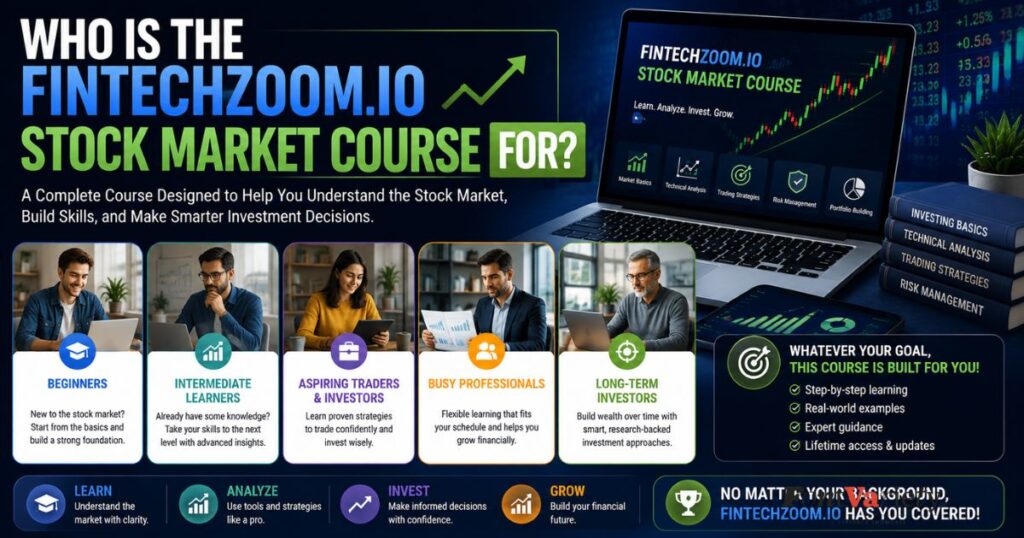
Course fit depends heavily on where you’re starting from and what you actually want out of the material. A course built to serve everyone from total beginners to advanced traders often ends up serving none of them particularly well, so it’s worth being honest about your own level before buying.
The marketing language around most stock market courses, including this one, tends to claim broad appeal. That’s a normal sales tactic, but it puts the burden on you to match the stated curriculum against your actual skill gaps rather than assuming the course was built with your situation in mind.
Below is a breakdown of who is likely to get value from a course like this, and who is better served by other resources entirely.
Beginners
If you don’t yet know how to read a stock quote or place a trade, a structured course can genuinely save time compared to hunting through scattered blog posts and videos. The fundamentals module should provide the vocabulary and context needed to make sense of everything more advanced.
The main risk for beginners is paying for structure they could get for free elsewhere. It’s worth comparing this course’s fundamentals section against free resources before assuming payment is necessary just to get started.
Intermediate Traders and Investors
Traders who already understand the basics but want to formalize technical analysis or risk management may find targeted value in the later modules. The usefulness here depends on whether the content goes beyond textbook definitions into practical application with real examples.
Intermediate learners should be the most skeptical buyers, since they’re the group most likely to already know the fundamentals section and pay for content they don’t need. Checking the syllabus for module-by-module depth matters more for this group than for total beginners.
Busy Self-Learners
Self-paced video content can work well for people who don’t have time for live classes or a formal program but still want a defined curriculum instead of random searching. The appeal is convenience and structure rather than necessarily superior content.
For this group, the real question is whether the course respects their time with concise, well-organized lessons, or pads runtime with filler. A syllabus with vague, repetitive-sounding module titles is often a warning sign of the latter.
Who May Not Be a Good Fit?
Advanced traders with years of market experience are unlikely to find much new material here, since the curriculum appears built for a beginner-to-intermediate audience. Anyone already using a professional platform or working with a licensed advisor probably won’t need this course either.
People looking for guaranteed returns or a shortcut to consistent profits should also skip it, and frankly any course that implies that outcome. No education product, from FintechZoom.io or otherwise, can promise trading results, and claims that suggest otherwise are a red flag regardless of the brand.
Trading Course vs Investing Course: Which One Fits You?
Trading and investing are related but distinct disciplines, and the FintechZoom.io course appears to blend both under one roof. Trading education focuses on shorter time horizons, chart-based decisions, and active risk management, while investing education focuses on longer-term portfolio construction and fundamental analysis.
If your goal is retirement savings or long-term wealth building, the investing and portfolio basics module is probably more relevant to you than the technical analysis sections. Conversely, if you want to trade actively, the risk management and psychology content will likely matter more than portfolio theory.
Buying a combined course makes sense if you genuinely want exposure to both disciplines, but it’s worth being honest that you may only use half the material. Matching your actual goal to the specific modules, rather than the course as a whole, is the more useful way to evaluate the purchase.
How Much Does the FintechZoom.io Stock Market Course Cost?
Pricing for online finance courses varies widely, often ranging from under a hundred dollars for basic packages to several hundred for programs with added support, community access, or bonus material. Because pricing pages change frequently and often include limited-time discounts, any specific number quoted in a review can go stale fast.
The most reliable approach is to check the current price directly on the FintechZoom.io checkout page rather than relying on older reviews or secondhand summaries, including this one. Screenshots of “before and after” pricing on sales pages are also common marketing tactics and shouldn’t be treated as a genuine limited-time offer without independent confirmation.
It’s also worth checking whether the stated price is a one-time payment or includes recurring fees for community access, updates, or additional tiers. Course pricing structures that aren’t clearly disclosed upfront are a reasonable reason to pause before purchasing.
Are the FintechZoom.io Course Instructors Credible?
Instructor credibility is one of the most important, and most often under-disclosed, factors in evaluating any paid finance course. Relevant credentials might include professional trading experience, licenses such as a Series 65 or CFA designation, or a verifiable track record, though not every legitimate educator holds formal certifications.
For the FintechZoom.io course specifically, instructor bios and credentials should be checked directly on the course page rather than assumed from the brand’s general market-commentary content. Being a finance media outlet does not automatically mean the course instructors have hands-on trading or investing experience.
If instructor names, backgrounds, and track records aren’t clearly listed, that’s worth treating as a gap rather than an oversight. A credible finance educator should be comfortable being named and having their background checked, and the absence of that information is a legitimate reason for caution.
Also Like To Read This: PressVibePulse Com Review 2026: What Is It, What Does It Offer & Is It Worth It?
FintechZoom.io Stock Market Course Pros and Cons
Weighing a course like this comes down to comparing what it plausibly offers against what remains unverified or unclear. Neither side should be taken as final until you’ve done your own direct research on the current course page and any independent feedback you can find.
The advantages below reflect the potential value of a structured, single-source curriculum, while the drawbacks reflect the real limitations of newer, less-established education brands. Both lists should be read as considerations, not conclusions.
Ultimately, the pros and cons matter less in isolation than they do relative to your specific starting point and goals, which is why the earlier “who is this for” breakdown is worth revisiting alongside this list.
Potential Advantages
A single structured curriculum can save time compared to self-directed learning across dozens of scattered sources. If the course delivers on organization and pacing, that convenience alone has real value for busy learners who want a clear path rather than open-ended research.
Bundling fundamentals, technical analysis, investing, and psychology into one course also means learners don’t have to seek out separate resources for each topic. For someone starting from zero, that consolidation can meaningfully reduce the friction of getting started.
Potential Drawbacks
The biggest drawback is the limited independent verification available for a newer course from a media-first brand. Without confirmed instructor credentials, visible student outcomes, or a detailed public syllabus, buyers are relying more on marketing than evidence.
There’s also the general risk that broad, all-in-one courses spread themselves thin across too many topics. Anyone who needs deep expertise in one specific area, like options trading or technical analysis alone, may be better served by a narrower, more specialized resource.
FintechZoom.io Stock Market Course vs. Free Learning Resources
Free stock market education is genuinely abundant, from brokerage-provided tutorials to long-form YouTube series and investor relations material from exchanges themselves. Much of the fundamentals content in any paid course, including this one, overlaps heavily with material that’s already available at no cost.
Where paid courses can justify their price is structure, pacing, and the removal of decision fatigue that comes from sorting through free content of uneven quality. If the FintechZoom.io course delivers a genuinely organized path with cohesive lessons, that’s the realistic value proposition, not access to secret information.
The practical test is simple: before paying, spend a few hours with free resources covering the same fundamentals module and see how far that gets you. If free content covers 80% of what you need, the paid course only needs to justify the remaining 20% to be worth it.
FintechZoom.io Stock Market Course vs. Other Online Investing Courses
Established investing and trading course providers, some with years of public track records, visible instructor credentials, and large student bases, exist as direct alternatives. Comparing the FintechZoom.io course against a couple of these established options is a reasonable step before committing.
The comparison should focus on concrete factors: syllabus depth, instructor transparency, refund policy, and independently verifiable student feedback. A newer entrant isn’t automatically worse, but it does carry more uncertainty than a provider with several years of public reviews behind it.
Price alone shouldn’t be the deciding factor in this comparison. A cheaper course with vague content and no verifiable credentials can be a worse value than a moderately priced course with a transparent syllabus and confirmed instructor background.
What You Should Check Before Buying the Course
Before paying for the FintechZoom.io Stock Market Course, or any similar product, a short due-diligence checklist can prevent an expensive mistake. None of these checks take more than a few minutes, and a legitimate course provider should have no problem satisfying all of them.
The sections below walk through the specific things worth confirming directly with FintechZoom.io before you buy, rather than assuming the sales page tells the full story.
Treat any resistance to these requests, vague answers, or missing information as a signal in itself. Legitimate education providers are generally transparent about exactly this kind of detail.
Ask for the Full Syllabus
A detailed, lesson-by-lesson syllabus tells you far more than a general topic list. Ask specifically how many lessons are in each module, roughly how long each one runs, and what format they take, whether video, text, or downloadable material.
If the seller can’t or won’t provide this level of detail before purchase, that’s a meaningful gap. A genuine curriculum should be describable in specifics, not just broad category names like “technical analysis” with nothing underneath.
Verify Instructor Credentials
Search the instructor’s name independently rather than relying on the bio provided on the course page. Look for verifiable professional history, any relevant licenses, and whether they have a public presence outside of the FintechZoom.io platform itself.
If you can’t find the instructor mentioned anywhere except the course’s own marketing material, treat that as a reason for extra caution. A real track record usually leaves some trace beyond a single sales page.
Confirm the Current Price
Course pricing pages change often, and discount countdowns are frequently used as pressure tactics rather than genuine limited-time offers. Check the live price directly on the FintechZoom.io site rather than trusting any number quoted in an older review.
Also check whether the listed price is truly one-time or whether it includes recurring charges for community access or content updates. Recurring fees that aren’t obvious upfront are a common source of buyer frustration later.
Read the Refund Terms
A clear, reasonable refund window is one of the simplest trust signals a course can offer. Look for the specific number of days, what conditions apply, and whether the policy is stated plainly rather than buried in fine print.
If refund terms are vague, hard to find, or contradicted between the sales page and checkout process, treat that as a real warning sign. Confident providers are generally willing to stand behind their content with a clear policy.
Check What Support You Actually Receive
Some courses include instructor Q&A, community access, or email support, while others are simply pre-recorded videos with no further contact. Confirm exactly what’s included before buying, since support level significantly affects whether the course is worth the price.
If community or support access is advertised, check whether it’s active and current rather than an abandoned forum or unanswered inbox. A support feature that exists on paper but isn’t actually functioning provides no real value.
Look for Independent Student Feedback
Search outside the course’s own website for mentions on forums, review sites, or social media from people who claim to have actually completed it. Independent feedback, even if limited, is far more reliable than testimonials curated by the seller.
If you can’t find any independent mentions at all for a course that claims to have existing students, that absence is itself useful information. It doesn’t automatically mean the course is illegitimate, but it does mean you’re taking on more uncertainty as an early buyer.
Can the FintechZoom.io Course Make You a Better Trader?
Any course, regardless of quality, can only provide knowledge and frameworks; it can’t guarantee trading results, and no legitimate provider should claim otherwise. Whether this course improves your actual trading depends far more on how you apply the material than on the course content alone.
The sections most likely to influence real performance are risk management and psychology, since most retail trading losses stem from poor discipline rather than a lack of technical knowledge. If those modules are genuinely strong, the course has a real shot at improving outcomes even if the technical analysis content is fairly standard.
Realistically, the course can accelerate your learning curve and organize scattered concepts into a coherent framework. It cannot replace practice, discipline, and the inevitable losses that come with real market experience, and any course implying it can should be treated with suspicion.
Quick Verdict: Is the FintechZoom.io Stock Market Course Worth It?
The honest answer is that it depends on your starting point and how much weight you put on unverified marketing claims versus confirmed details. For total beginners who value structure and are willing to accept some uncertainty about a newer brand, the course could be a reasonable, moderate-cost starting point.
For intermediate or advanced learners, or anyone unwilling to buy without verified instructor credentials and independent feedback, it’s harder to recommend without more transparency from FintechZoom.io itself. The overlap with free resources also means the course needs to clearly earn its price through organization and depth, not just convenience.
Before buying, work through the due-diligence checklist above: confirm the syllabus, verify the instructors, check the current price and refund terms, and look for independent feedback. If those checks come back solid, the course is a reasonable bet; if they come back empty, that’s your answer too.
FAQ’s
Is the FintechZoom.io Stock Market Course legitimate?
There’s no clear evidence either way from public information alone, since FintechZoom.io is primarily known as a finance media site rather than an established education provider. Legitimacy here depends on details you’d need to verify directly, like instructor credentials, a real syllabus, and independent student feedback, rather than anything that can be confirmed from the sales page.
Does the course guarantee trading profits?
No course, from FintechZoom.io or any other provider, can legitimately guarantee trading or investing profits. If any marketing material implies guaranteed returns, treat that as a red flag rather than a selling point, since it goes against how financial markets actually work.
Is this course better than free resources like YouTube or brokerage tutorials?
Not necessarily. Much of the fundamentals content overlaps with material that’s freely available, and the paid course only justifies its price through structure, pacing, and depth beyond what free content offers. Testing free resources first is a reasonable way to see how much value the paid version would actually add.
Who is the FintechZoom.io Stock Market Course best suited for?
Based on the marketed curriculum, it appears best suited to beginners who want a single structured path rather than scattered self-study. Intermediate and advanced traders are less likely to find new material, especially in the earlier fundamentals sections.
How much does the course cost?
Pricing isn’t reliably stated in public reviews and can change without notice, so the only accurate source is the current checkout page on FintechZoom.io itself. Always confirm whether the price is one-time or includes any recurring fees before purchasing.
Can I get a refund if the course isn’t a good fit?
That depends entirely on FintechZoom.io’s stated refund policy at the time of purchase, which should be checked directly before buying. A clear, reasonable refund window is a positive trust signal, while vague or hidden terms are worth treating as a caution flag.
Conclusion
The FintechZoom.io Stock Market Course positions itself as an all-in-one path from market basics to trading and investing skills, but much of what makes it worth paying for, instructor credibility, actual student outcomes, and course depth, remains unverified from the outside. That doesn’t mean it’s a bad product; it means the burden of confirmation sits with the buyer rather than the marketing copy.
If you’re a beginner drawn to the convenience of a single structured curriculum, it may be worth a closer look, provided you run through the due-diligence checklist first: syllabus, instructor background, current pricing, refund terms, and independent feedback. If those checks hold up, the course could be a reasonable investment in your own education; if they don’t, free resources can cover much of the same ground without the financial risk.