


If you’ve come across CNLawBlog while searching for legal information online, you’re probably wondering whether it’s a credible resource or just another content site riding on popular keywords. This review breaks down what CNLawBlog actually is, what it covers, and how it compares to more established legal sources.
We’ll also clear up the common confusion between CNLawBlog and the older, unrelated “China Law Blog,” look honestly at content quality, and explain exactly who should (and shouldn’t) rely on this kind of platform. By the end, you’ll have a realistic, balanced picture of where CNLawBlog fits into your legal research process.
What Is CNLawBlog?
CNLawBlog is an independent digital publication that presents itself as a source of legal articles, guides, and general legal awareness content. Rather than operating as a law firm or a government body, it functions as an educational blog aimed at readers who want a simplified entry point into legal topics. Its content style leans toward plain-language explanations instead of dense legal drafting.
For readers hearing the name for the first time, CNLawBlog can feel like a one-stop resource because it touches on many legal categories at once. This broad approach makes it approachable, but it also means the depth of coverage on any single topic is usually general rather than expert-level. It works best as a starting point rather than a final authority.
It’s worth remembering that CNLawBlog does not claim to be an official legal database, a court resource, or a licensed law practice. Understanding this upfront sets realistic expectations before you read further into what the site actually offers and how it should be used.
Clearing Up the Name Confusion
One of the most common points of confusion around CNLawBlog is its similarity in name to “China Law Blog,” a much older publication hosted on the Harris Sliwoski LLP website since 2006. The two are separate publications with different owners, different scopes, and different editorial goals, despite the overlapping branding.
China Law Blog focuses specifically on practical legal issues tied to doing business in or with China, including trade, manufacturing, contracts, and dispute resolution. CNLawBlog.com, on the other hand, has a broader editorial scope that extends well beyond China-related law into general legal education and several unrelated categories.
To avoid mixing up the two, always double-check the full domain name before treating any article as coming from a particular source. This small habit prevents misattributing legal claims and helps readers correctly separate a law-firm publication from a general content blog.
The Site’s Broad Range of Topics
CNLawBlog does not limit itself strictly to law. While legal content remains a core focus, the platform also publishes articles on finance, business, technology, education, health, real estate, and lifestyle topics. This multi-topic structure is fairly common among content-driven blogs that aim to capture a wide readership.
| Category | Typical Content Focus |
| Law | General legal explainers, awareness articles |
| Business | Corporate compliance, workplace regulations |
| Finance | Basic financial and consumer guidance |
| Technology | General tech and digital topics |
| Health, Lifestyle, Real Estate | General informational content |
Because the site spans so many categories, readers should treat each article on its own merits rather than assuming uniform depth across the whole platform. A well-researched legal piece does not guarantee the same rigor in an unrelated lifestyle post, and vice versa.
This variety can be useful for casual browsing, but anyone specifically seeking legal information should focus narrowly on the law-related sections and evaluate those articles independently from the rest of the site’s content.
How CNLawBlog Approaches Legal Education
The stated goal behind CNLawBlog’s legal content is accessibility. Legal terminology is often difficult for non-specialists, and the site tries to break down complex ideas into shorter, reader-friendly explanations aimed at students, professionals, and general audiences alike.
This approach typically favors summaries over exhaustive analysis. Instead of walking through statutes or case law in technical depth, articles tend to explain what a concept means in everyday terms and why it might matter to an ordinary reader.
That trade-off is reasonable for a first introduction to a topic, but it does mean the content is not a substitute for the detailed, case-specific reasoning that a licensed attorney would provide. Readers should see this educational style as a starting point for further research, not a final answer.
The Role of Legal Blogs in the Digital Era
Legal blogs like CNLawBlog have grown in popularity because they fill a gap between dense official legal text and everyday reader comprehension. People increasingly search online before consulting a professional, and accessible content meets that initial curiosity.
This shift has made legal literacy more attainable for the general public, since readers can now get a rough understanding of terms like contracts, compliance, or employment rights without first hiring a lawyer. It lowers the barrier to entry for basic legal awareness.
At the same time, this convenience comes with responsibility. Digital-era legal blogs work best when readers use them for orientation and then verify anything consequential through official sources or licensed professionals.
Key Content Areas Covered by CNLawBlog
Based on how the site is generally described, its legal section tends to touch on a recurring set of themes rather than deeply specialized practice areas.
| Content Area | What It Usually Covers |
| Business Law | Corporate compliance, basic regulatory topics |
| Intellectual Property | General IP protection concepts |
| Employment Law | Workplace rights and regulations overview |
| General Legal Awareness | Everyday legal terms and processes |
These recurring categories suggest the blog is oriented toward broad legal literacy rather than niche or highly technical practice areas, which aligns with its stated educational mission.
How CNLawBlog Simplifies Complex Legal Concepts
Simplification usually happens through shorter paragraphs, everyday vocabulary, and framing legal ideas around common situations a reader might recognize, rather than quoting statutory language directly.
This method makes the content more digestible for someone with no legal background, since it avoids jargon-heavy explanations that could otherwise discourage a first-time reader from finishing the article.
The limitation is that simplification can sometimes strip away important nuance, such as jurisdiction-specific rules or exceptions. Readers should treat simplified explanations as a general map, not a precise legal roadmap for their exact situation.
Importance of Accurate and Reliable Legal Information
Accuracy matters more in legal content than in most other niches, because a misunderstood concept can lead to poor real-world decisions. This is why editorial transparency and sourcing practices matter when judging any legal blog.
CNLawBlog has reportedly published an editorial policy describing how topics are selected and reviewed, referencing sources such as government sites, official organizations, and public reports as part of its research process.
Even with a stated editorial process, readers should still cross-check anything important against primary or official sources, especially before making decisions with legal or financial consequences.
Evaluating the Reliability of Legal Content Websites
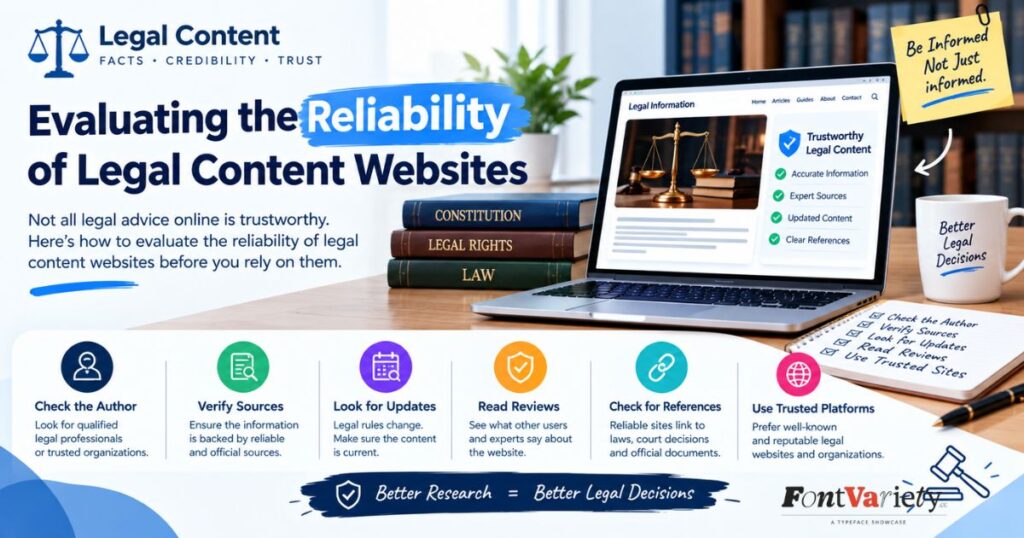
Reliability for a legal content site depends on a combination of factors: transparency about ownership, clarity about the site’s purpose, sourcing practices, and how clearly it separates general education from professional advice.
CNLawBlog appears to position itself clearly as an independent publication rather than a law firm, which is a positive transparency signal. However, being transparent about its role does not automatically make every individual article equally well-researched.
The most practical approach is to judge reliability article by article rather than site-wide, checking whether claims are sourced, whether the tone avoids overpromising legal certainty, and whether it encourages readers to seek professional advice for specific cases.
SEO and Digital Visibility of Legal Platforms
Legal content sites, including CNLawBlog, compete in a search landscape where “legal” and “law” related keywords are highly searched and often commercially valuable. This creates strong incentive for platforms to invest in SEO to stay visible.
Effective SEO for legal platforms typically combines clear topic structuring, keyword-relevant headings, internal linking between related legal articles, and consistent publishing to build topical authority over time in search engines.
Because legal searches often come from people trying to solve a real problem, visibility alone isn’t enough; platforms also need to maintain content quality so that ranking well translates into genuinely useful reader experiences rather than just traffic numbers.
How Taqneeq Marketing Agency Can Enhance CNLawBlog
A specialized digital marketing partner like Taqneeq Marketing Agency could help a platform such as CNLawBlog strengthen its search visibility through structured keyword research, on-page optimization, and content strategy tailored to legal search intent.
Beyond technical SEO, an agency’s involvement could support better content planning, such as organizing articles into topic clusters, improving internal linking, and ensuring headings and metadata align with how readers actually search for legal information.
This kind of support does not change the underlying legal accuracy of the content, but it can improve how efficiently well-written, accurate articles reach the readers who are actually looking for that information.
CNLawBlog Content Quality: A Realistic Look
Content quality across CNLawBlog appears mixed in the way it is described across independent reviews, with some articles offering clear, well-organized explanations and others reading as more general or filler-oriented.
This kind of variation is common among broad, multi-topic blogs that publish frequently across many categories, since maintaining uniformly high depth across dozens of legal subtopics is genuinely difficult to sustain at scale.
A realistic reader expectation is that CNLawBlog can be useful for quick orientation on a topic, but individual articles should still be evaluated on their own clarity, sourcing, and whether they overstate certainty on complex legal matters.
Who Should Use CNLawBlog (And Who Should Not)
CNLawBlog is generally well suited to students researching legal concepts for coursework, professionals in non-legal fields who want general awareness, and curious readers trying to understand a term they’ve encountered elsewhere.
It is less suited to anyone facing an active legal dispute, a time-sensitive legal decision, or a situation with real financial or personal stakes, since general blog content cannot account for jurisdiction-specific rules or individual case facts.
| Good Fit | Poor Fit |
| Students and general learners | Active legal disputes |
| Casual research and orientation | Time-sensitive legal decisions |
| Building baseline legal vocabulary | Case-specific legal strategy |
Matching the right reader to the right use case is the simplest way to get genuine value from the site without over-relying on it.
Honest Verdict: CNLawBlog Scorecard
Weighing CNLawBlog’s strengths and limitations together gives a more balanced picture than a simple yes-or-no verdict on trustworthiness.
| Factor | Assessment |
| Accessibility | Strong content is easy to read |
| Topic Breadth | Wide, but not deeply specialized |
| Depth of Legal Analysis | Limited compared to professional sources |
| Transparency | Reasonable, with a stated editorial approach |
| Suitability for Legal Advice | Not suitable; educational use only |
Overall, CNLawBlog earns reasonable marks as an educational starting point, while falling short of the standard needed for case-specific legal reliance.
CNLawBlog Is Not a Replacement for a Lawyer
No matter how clearly an article is written, reading a legal blog post does not create an attorney-client relationship, and it cannot account for the specific facts of an individual’s situation the way a licensed professional can.
CNLawBlog’s own general positioning as an educational resource, rather than a legal service provider, reinforces this distinction. It is designed to inform, not to represent or advise anyone on a live legal matter.
Anyone dealing with a real legal issue a contract dispute, an employment conflict, or a regulatory question should treat blog content as background reading only and consult a qualified lawyer for guidance specific to their case.
Also Like To Read This: WallPostMedia com Review 2026: Best Features, Pricing, Pros, Cons & How It Works
A More Practical Way to Use CNLawBlog
A more effective way to use CNLawBlog is to treat it as a glossary and orientation tool rather than a decision-making resource. Read an article to understand a concept, then verify anything important through a primary or official source.
This approach lets readers benefit from the site’s simplified explanations without over-relying on any single article’s framing of a legal issue, which reduces the risk of acting on incomplete or overly generalized information.
Combining CNLawBlog with official government resources, bar association materials, or a quick consultation with a professional creates a more balanced research process than depending on any one blog alone.
What Kind of Reader Can Benefit From CNLawBlog?
The clearest beneficiaries are readers who are early in their learning process: students building foundational legal vocabulary, small business owners trying to understand basic compliance terms, or anyone preparing questions before meeting a lawyer.
These readers benefit because CNLawBlog’s simplified format helps them arrive at a professional conversation already familiar with key terms, which can make that conversation more efficient and focused.
Readers who need precise, actionable legal guidance for an active situation will generally find the content too general for their needs and should look toward professional or official resources instead.
How the Main Website Positions Itself
CNLawBlog generally positions itself as an independent digital publication rather than a government portal, law firm, or academic institution, and it does not claim authority equivalent to those official sources.
This self-positioning matters because it sets the correct frame for readers: the site is offering general commentary and education, not authoritative legal determinations or case-specific representation.
Recognizing this framing helps readers approach the content with appropriate expectations, treating it as one input among several rather than a definitive legal reference.
Recognizing Spam and Low-Quality Content Around Popular Search Terms
Popular legal search terms, including branded terms like “CNLawBlog,” can attract low-quality or spam-style content trying to capitalize on search traffic rather than genuinely inform readers. This is a broader pattern across many trending keywords online.
Warning signs of such content include vague claims without sourcing, reposted or lightly reworded articles, excessive keyword stuffing, and pages that promise definitive legal answers without any caveats about individual circumstances.
| Trustworthy Signals | Spam or Low-Quality Signals |
| Clear sourcing and editorial policy | No sourcing or vague claims |
| Balanced, hedged language | Overpromising definitive answers |
| Original, well-structured writing | Reworded or duplicated content |
Being alert to these patterns helps readers filter out noise and focus on genuinely useful explanations, whether on CNLawBlog or elsewhere.
Using Legal Blogs Responsibly
Responsible use of any legal blog starts with understanding its purpose: general education, not personalized advice. Readers should treat articles as a first step in understanding a topic rather than the final word on it.
It also helps to cross-reference claims across more than one source, particularly for anything involving deadlines, regulations, or rights, since laws can vary significantly by jurisdiction and change over time.
Finally, responsible use means knowing when to stop reading and start consulting a professional specifically, once a general question turns into a specific situation with real consequences attached to the outcome.
Building Legal Literacy Over Time
Legal literacy is best built gradually, through repeated exposure to basic concepts across multiple reliable sources rather than a single deep read of one article. Sites like CNLawBlog can play a small but useful role in that gradual process.
Over time, combining accessible blog content with official resources, professional consultations, and formal education (where relevant) builds a more well-rounded understanding of how legal systems actually function.
The end goal of this kind of learning isn’t to replace professional legal advice, but to make readers more informed participants in their own legal and business decisions, better equipped to ask the right questions when it matters most.
Frequently Asked Questions
Is CNLawBlog a law firm or a government website?
No. CNLawBlog is an independent digital publication that publishes educational legal content. It is not a law firm, court, or official government resource, and it does not offer legal representation.
Is CNLawBlog the same as China Law Blog?
No. CNLawBlog.com is a separate, broader publication covering multiple topics including law. China Law Blog is an older, China-focused legal publication hosted on the Harris Sliwoski LLP website since 2006.
Can I use CNLawBlog instead of hiring a lawyer?
No. CNLawBlog is meant for general education and orientation. Any active legal issue, dispute, or decision with real consequences should be reviewed by a licensed attorney familiar with your specific facts and jurisdiction.
Is the information on CNLawBlog accurate?
The site reportedly follows an editorial policy referencing government sources and public reports, but content depth and accuracy can vary by article. It’s best to verify important claims against primary or official sources.
Who benefits most from reading CNLawBlog?
Students, business owners seeking basic awareness, and general readers wanting to understand legal terminology before a professional consultation tend to benefit the most.
Does CNLawBlog only cover legal topics?
No. While law is a core focus, the site also publishes content on finance, business, technology, health, real estate, and lifestyle topics.
Conclusion
CNLawBlog is best understood as an accessible, general-education legal blog rather than an authoritative legal source. Its simplified explanations make it a useful entry point for readers who are new to a topic, but its broad scope and general style mean it can’t substitute for professional legal advice or official documentation.
Used the right way as a starting point for learning, not a final answer for decision-making CNLawBlog can genuinely help build legal literacy over time. Just remember to verify anything important, watch for the name confusion with China Law Blog, and consult a licensed lawyer whenever real stakes are involved.