

Onlyworkmoods.com is a work-life platform that aims to provide useful content around modern working habits, productivity, and professional life. With more people looking for practical ways to manage work and daily responsibilities, platforms like this can attract readers seeking simple and relevant information.
In this review, we take a closer look at what Onlyworkmoods.com offers, the type of content users may find, and how the platform presents its information. The goal is to give readers a clear overview before they spend time exploring the website.
Whether you are interested in workplace ideas, productivity topics, or general work-life content, understanding the platform’s purpose can help you decide whether it matches your needs. Let’s explore Onlyworkmoods.com and what it really offers.
The Philosophy Behind Onlyworkmoods.com
Onlyworkmoods.com is built on the idea that professional performance and emotional well-being cannot be separated from each other. Rather than treating productivity as a purely mechanical output of tools and schedules, the platform frames work as something shaped by mood, energy, and mental state. This gives its content a more human tone than the average productivity blog.
The underlying belief seems to be that readers do better work when they understand themselves first. Articles lean toward self-awareness, routine-building, and emotional regulation as much as they do toward technical career advice. This positions Onlyworkmoods.com closer to a lifestyle and personal-development resource than a pure business publication.
That said, the philosophy is expressed mostly through general-interest articles rather than a structured framework or proprietary methodology. Readers looking for a defined system, like a named productivity model, won’t find one here. What they will find is a consistent editorial voice that keeps circling back to the connection between how people feel and how they work.
Navigating the Content Structure of the Platform
The site is organized as a multi-topic publication rather than a narrow, single-purpose tool. Content is grouped loosely around themes such as careers, productivity, personal finance, technology, and lifestyle, which means visitors move between very different kinds of articles depending on what they click. This broad structure is common among modern content sites aiming to capture varied search traffic.
Because the name suggests something narrower, like a mood-tracking app, first-time visitors often need a moment to recalibrate expectations. Once that adjustment happens, the layout is straightforward: article-based pages, category browsing, and a search function, without any account system or interactive dashboard to learn. This keeps the barrier to entry low.
The tradeoff of this structure is depth. A site covering this many subjects can’t go as deep into any single one as a specialized publication might. For readers who want broad, accessible reading rather than expert-level analysis, the structure works well; for those wanting a focused resource, it may feel scattered.
How Does OnlyWorkMoods.com Work?
In practice, the site works the way most content publications do: articles are published, categorized, and made discoverable through internal navigation and search engines. There’s no login, subscription tier, or software component to set up. You arrive, read, and move on.
This simplicity is arguably the point. Rather than asking visitors to learn an interface, Onlyworkmoods.com functions as a reading destination. New articles are added over time, and returning visitors typically come back for fresh content rather than to interact with any ongoing personal data or tracked history.
Because there’s no account system, there’s also no personalization based on past behavior. Every visitor sees essentially the same content library, organized the same way, which keeps the experience predictable but not tailored.
What Can You Find on OnlyWorkMoods.com?
Expect articles on career development, remote work habits, workplace culture, productivity tips, and occasional detours into personal finance, technology explainers, and general lifestyle topics. The range is intentionally wide rather than narrow.
This means you might land on a piece about managing burnout one visit and a general technology explainer the next. Readers hoping for a single, tightly-scoped knowledge base on one subject may find the variety distracting, while readers who enjoy general-interest browsing may appreciate the breadth.
The consistent thread across most articles is a focus on the workplace and the person navigating it, even when the specific topic wanders into adjacent lifestyle territory.
ALso Like To Read This: Test.com Pricing Enterprise Plans: Complete Guide to Features, Costs & Value
How Can We Best Make Use of OnlyWorkMoods.com?
The most practical way to use the site is as a supplementary reading resource rather than a primary planning tool. Treat it the way you would a general-interest magazine: browse for ideas, save what resonates, and cross-check anything with real stakes against more authoritative sources.
Because there’s no tracking or interactive feature set, there’s nothing to configure. The best approach is simply to search for topics relevant to your current situation, whether that’s remote work fatigue or career transition anxiety, and read a few articles rather than relying on one.
It also helps to treat the content as a starting point for reflection rather than a finished answer. Many articles raise useful questions about mindset and routine without prescribing a rigid step-by-step plan.
Can OnlyWorkMoods.com Satisfy All My Research Needs?
Not entirely, and it isn’t really designed to. As a general-interest content site, it’s better suited to inspiration, mindset shifts, and light guidance than to rigorous, citation-backed research. Readers with academic, legal, or highly technical needs should look elsewhere.
For everyday questions about workplace habits, motivation, or work-life balance, the content is reasonably accessible and easy to digest. But it shouldn’t be treated as the final word on any topic that requires expert verification, such as employment law or financial planning.
A balanced approach is to use the site for perspective and easy reading, then supplement with specialized resources when a decision actually matters, like negotiating a contract or making a major career move.
Common Mistakes People Make When Exploring Websites
One common mistake is assuming a site’s name accurately describes its function. With Onlyworkmoods.com, the name suggests a mood-tracking tool, but the reality is a general content publication, which can lead to disappointed expectations if visitors don’t adjust.
Another frequent error is treating any single article as definitive advice rather than one perspective among many. Content sites like this one are written for accessibility, not for exhaustive accuracy, so cross-referencing matters more than it might on a specialized industry publication.
People also sometimes overlook the difference between browsing casually and researching seriously. Using a general-interest site for quick ideas is fine; relying on it exclusively for decisions with real consequences is where problems tend to show up.
Who Might Find OnlyWorkMoods.com Interesting?
Remote and hybrid workers looking for relatable commentary on modern work challenges are a natural audience, since much of the content addresses the blurred lines between home and office life. Freelancers navigating unpredictable schedules may also find some articles relevant.
Early- and mid-career professionals interested in soft-skill development, like emotional intelligence or resilience, are another likely audience, given the site’s recurring focus on mindset alongside productivity. Casual readers who enjoy lifestyle and self-improvement content more broadly may enjoy it too.
It’s less suited to specialists seeking deep technical or industry-specific expertise, HR professionals needing compliance-grade information, or anyone requiring peer-reviewed or heavily sourced material.
Key Benefits of Exploring onlyworkmoods com
The clearest benefit is accessibility: no signup, no cost barrier, and no learning curve. Readers can dip in and out without commitment, which suits people who want light, occasional reading rather than an ongoing platform relationship.
The breadth of topics is also a benefit for readers who like variety, since a single visit can touch on careers, technology, and lifestyle without needing to switch sites. This can save time for casual browsing sessions.
Finally, the emphasis on emotional and mental factors alongside practical work advice fills a gap that purely technical productivity resources often leave open, offering a more rounded perspective on what makes a workday sustainable.
Features and User Experience of onlyworkmoods com
The user experience mirrors a standard online magazine: category navigation, a search bar, and individual article pages with minimal friction. There isn’t a dashboard, tracker, or interactive tool to speak of, so the “features” are really editorial rather than functional.
| Feature | Present on Onlyworkmoods.com? |
| Mood or productivity tracking tool | No |
| Account or login system | No |
| Searchable article library | Yes |
| Multi-topic content (careers, lifestyle, tech, finance) | Yes |
| Community or comment features | Limited/varies |
| Cost to access | Free |
This table reflects what several independent overviews of the site describe, and it’s worth keeping in mind when setting expectations before visiting.
For readers who prefer simple, low-friction reading experiences, this stripped-down structure works in the site’s favor. For those expecting app-like functionality based on the name, it may initially feel like a mismatch.
Important Topics Covered by Onlyworkmoods com
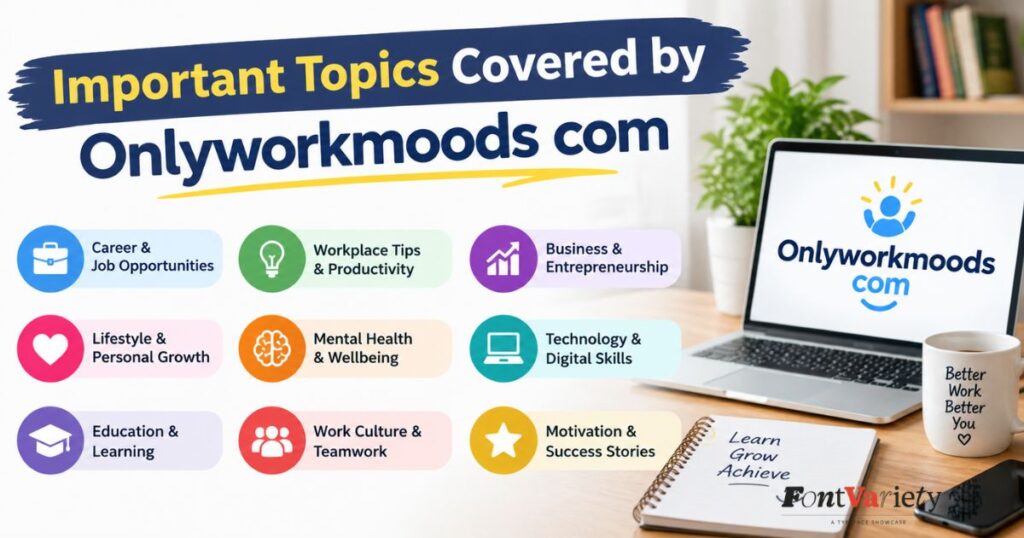
Recurring themes include remote work adaptation, workplace emotional intelligence, burnout prevention, career development, and general productivity habits. These sit alongside more general lifestyle and personal-finance pieces that broaden the site’s overall footprint.
The workplace-focused content tends to emphasize the human side of work, mindset, motivation, and resilience, rather than technical skill-building like software tutorials or certification guides. This gives the site a softer, more reflective tone compared to purely tactical career resources.
Because coverage spans several unrelated categories, the depth on any one topic varies. Some articles are fairly thorough; others read as brief overviews meant to introduce a concept rather than fully explore it.
Onlyworkmoods com Compared With Other Workplace Platforms
Unlike dedicated productivity software or mood-tracking apps, Onlyworkmoods.com doesn’t offer any interactive tool, data logging, or personalized dashboard. It’s a content site, not a SaaS product, so comparisons to app-based competitors need that distinction in mind.
Compared with narrower career-advice publications, its scope is wider but shallower, touching on finance, tech, and lifestyle in addition to work topics. Specialized outlets focused solely on careers or HR may offer more depth in that specific lane.
Compared with general lifestyle magazines, it leans more heavily on workplace and career themes as an anchor, even as it wanders into adjacent subjects, which gives it a slightly more focused identity than a purely generic lifestyle blog.
Why So Many People Are Searching This Exact Phrase
Much of the search interest appears to stem from the name itself creating curiosity or confusion. “Onlyworkmoods” sounds like it could be a mood-tracking app or workplace analytics tool, prompting people to search the exact phrase just to clarify what the site actually is.
This pattern is common with unusual or evocative domain names: the search volume reflects uncertainty as much as genuine demand for the content itself. Several independent explainer articles have been written specifically to answer “what is this site” style questions.
As the site has grown its content library since launching in 2023, some of the search volume likely also reflects returning readers and organic interest in its articles, separate from the name-clarification searches.
How the Site Is Structured
Structurally, the site functions like a typical content management system-based publication: categorized articles, a homepage that surfaces recent or featured posts, and internal links connecting related topics. There’s no multi-tiered membership structure or gated content that has been widely reported.
Navigation relies on standard menus and search rather than any personalized recommendation engine tied to a user profile, since there’s no login system driving that kind of customization. This keeps the site’s technical footprint relatively simple compared to app-based platforms.
This straightforward structure supports quick, ad hoc reading rather than sustained, session-based engagement, which fits its identity as an informational publication rather than a tool people log into regularly.
Is It Actually Useful? Pros and Cons
| Pros | Cons |
| Free and accessible, no signup required | No personalization or account features |
| Broad topic coverage in one place | Limited depth on any single subject |
| Approachable tone on emotional/workplace topics | Not a substitute for expert or technical resources |
| Easy to browse casually | Name can create mismatched expectations |
Overall usefulness depends heavily on what a reader expects going in. As a casual, free source of workplace and lifestyle reading, it holds up reasonably well.
As a research tool for high-stakes decisions or a substitute for specialized software, it falls short, simply because that isn’t what it’s designed to be. Setting the right expectation from the start makes the difference between satisfaction and disappointment.
The Intersection of Workplace Productivity and Personal Well-being
A recurring theme across the site’s content is that productivity and well-being aren’t competing priorities but interconnected ones. Articles frequently suggest that sustainable output depends on managing energy and mood, not just managing time and tasks.
This framing pushes back against older productivity advice that focused almost entirely on tactics like scheduling and prioritization while ignoring the psychological state of the person doing the work. It’s a perspective that has gained traction more broadly in workplace writing over the past few years.
Whether or not a reader agrees with every specific suggestion, the emphasis on well-being as a productivity input rather than a separate concern is a reasonably grounded starting point, especially for anyone who has experienced burnout from purely tactic-driven approaches.
Addressing the Challenges of Modern Remote Work
Remote and hybrid work introduce challenges that traditional office-based advice doesn’t always cover, such as blurred boundaries between home and work, isolation, and difficulty separating “on” and “off” states. Content on the site frequently touches on these issues.
Articles tend to address practical friction points, like maintaining structure without an office environment, staying connected to colleagues, and avoiding the creep of work into personal time. These are common pain points reported by remote workers more broadly.
The advice is generally conceptual rather than tool-specific, meaning readers won’t find software recommendations so much as mindset and habit suggestions for managing the remote work experience more sustainably.
The Role of Emotional Intelligence in Career Growth
Emotional intelligence, the ability to recognize and manage one’s own emotions and respond well to others, shows up as a recurring thread in career-focused content. The underlying argument is that technical skill alone doesn’t guarantee career progress without the ability to navigate relationships and self-regulate under pressure.
This aligns with broader research in organizational psychology suggesting that interpersonal skills often matter as much as technical competence for long-term career advancement, particularly in leadership roles. The site’s content generally reflects this widely accepted idea rather than introducing a new framework.
For readers early in their careers, this emphasis can be a useful reminder that soft skills deserve deliberate attention alongside technical development, even if the site doesn’t offer a structured curriculum for building them.
Utilizing Search and Discovery Features for Targeted Results
Given the breadth of topics covered, the search function is the most efficient way to find relevant content rather than browsing categories at random. Typing specific terms, like “remote work burnout” or “career transition,” tends to surface more useful results than general browsing.
Because there’s no personalization engine, search results are the same for every visitor, which means the quality of your query matters more than it would on a platform with adaptive recommendations. Being specific pays off.
For readers who know roughly what they’re looking for, this straightforward search-driven discovery is efficient enough. For those hoping to be served content based on past interests, the lack of personalization will feel like a limitation.
Cultivating a Sustainable Professional Routine
Building a routine that holds up over time requires more than motivation on a good day; it requires structure that survives bad days too. Content addressing this topic tends to focus on small, repeatable habits rather than dramatic overhauls.
The emphasis on sustainability over intensity reflects a broader shift in productivity thinking away from all-or-nothing approaches. A routine that’s too rigid or demanding tends to collapse under real-world pressure, which is a fair point regardless of the source.
Practical suggestions in this space usually center on realistic pacing, regular breaks, and routines flexible enough to absorb disruption without falling apart entirely, which is generally sound, low-risk advice for most readers.
The Importance of Community and Shared Experience
Feeling isolated at work, especially in remote settings, is a common complaint, and content addressing community reflects that reality. Shared experience, whether through colleagues, peer groups, or online communities, is often framed as a buffer against burnout and disengagement.
This isn’t a novel insight, but it’s a well-supported one: social connection at work is consistently linked to better morale and resilience in workplace research more broadly. Articles touching on this theme tend to encourage readers to seek out or build these connections deliberately.
Since the site itself doesn’t offer built-in community features like forums or comment sections in any prominent way, this content functions more as encouragement to build community elsewhere than as a way to participate in one on the platform itself.
Building Resilience Against Workplace Burnout
Burnout content typically covers recognizing early warning signs, like chronic exhaustion or cynicism toward work, before they become severe. Early recognition is generally considered more effective than trying to recover after burnout has fully set in.
Suggested strategies tend to focus on boundary-setting, workload awareness, and small recovery habits rather than dramatic interventions, which is consistent with general workplace wellness guidance found elsewhere. None of it substitutes for professional support when burnout is severe.
Readers dealing with serious or persistent burnout symptoms should treat general content like this as a starting point for reflection, not a replacement for speaking with a manager, HR professional, or mental health provider if things aren’t improving.
Future-Proofing Your Career with Emotional Awareness
As automation and AI reshape many technical tasks, the argument goes that distinctly human skills, including emotional awareness, become more valuable rather than less. This is a common theme across career-development writing generally, and it shows up here too.
The practical suggestion is usually to pair technical upskilling with deliberate attention to self-awareness and interpersonal skill, rather than assuming technical competence alone will be enough to stay competitive over time.
This is reasonable, forward-looking advice, though it’s worth noting it’s a general industry trend rather than something unique to this particular site’s perspective.
Integrating Feedback and Continuous Improvement
Content in this area typically encourages treating feedback, from managers, peers, or self-reflection, as a routine input rather than an occasional, uncomfortable event. Normalizing feedback as ongoing tends to reduce the anxiety often attached to formal reviews.
The suggested approach usually involves small, regular check-ins rather than waiting for annual performance reviews to course-correct, which mirrors advice found in much of modern management writing.
This is a low-risk, generally useful habit to adopt regardless of where the advice comes from, since regular reflection tends to catch small issues before they compound into larger ones.
Practical Applications for Daily Professional Life
Translating general advice into daily habits is where a lot of readers get stuck, and the site’s content generally tries to bridge that gap with concrete, small-scale suggestions rather than abstract theory alone.
Examples typically include short daily check-ins with oneself about energy and mood, simple boundary-setting practices for remote workers, and brief reflection habits at the start or end of a workday. None of these require special tools to implement.
The value here is in the low barrier to trying something: most suggested practices take only a few minutes and don’t require restructuring an entire workday, which makes them realistic to test without much commitment.
The Evolving Landscape of Professional Resources
The broader shift toward multi-topic, emotionally-aware content publications like this one reflects changing expectations about what career resources should look like. Readers increasingly want practical advice framed around real human experience rather than purely clinical, tactic-based content.
This evolution mirrors a wider trend in online publishing, where niche and semi-niche sites blend several adjacent topics, careers, wellness, lifestyle, finance, to capture a broader readership than a single-subject site could.
Whether this trend continues to serve readers well will likely depend on whether sites in this space maintain enough depth and accuracy to stay genuinely useful, rather than optimizing purely for search visibility over substance.
Frequently Asked Questions
Is Onlyworkmoods.com a mood-tracking app?
No. Despite the name, it functions as a general content publication with articles on careers, productivity, lifestyle, and related topics, not a piece of tracking or analytics software.
Do I need to create an account to use the site?
No account or login appears to be required. Visitors can browse and read articles freely without signing up for anything.
Is the content on Onlyworkmoods.com free?
Yes, the site operates as a free-to-read publication with no reported paywall or subscription tier.
What topics does the site cover?
Primarily careers, remote work, productivity, and workplace emotional intelligence, with additional articles on personal finance, technology, and general lifestyle subjects.
Is Onlyworkmoods.com a reliable source for research or professional decisions?
It’s better suited to general reading and light guidance than to decisions with real stakes. For legal, financial, or highly technical matters, it’s worth cross-checking with specialized or authoritative sources.
Why do so many people search this exact phrase?
Largely because the name is ambiguous and sounds like it could be a workplace app, prompting curious searchers to look up what the site actually is before reading its content.
Conclusion
Onlyworkmoods.com turns out to be something simpler than its name suggests: a free, multi-topic content publication centered on work, careers, and the emotional side of professional life, rather than a specialized mood-tracking or productivity tool. Its value lies in accessible, easy-to-read articles that treat well-being and productivity as connected rather than separate concerns.
For casual readers looking for relatable perspectives on remote work, burnout, and career growth, it’s a reasonable, low-commitment resource to browse. For anyone needing deep expertise, personalized tools, or research-grade rigor, it’s best treated as a starting point rather than a destination, with more specialized sources brought in for anything that actually carries consequences.