

Choosing an enterprise testing platform is as much a budgeting exercise as it is a product decision, and Test.com pricing for enterprise plans reflects that complexity. Unlike simple flat-rate consumer plans, enterprise pricing blends a base license fee with usage-based charges, custom features, and negotiated contract terms. This guide breaks down exactly what drives those costs, what’s included at the enterprise level, and how to get the most value out of your contract.
Whether you’re comparing Test.com’s enterprise tier against its standard plans for the first time or trying to make sense of a quote you’ve already received, this guide walks through every major cost driver, from the base $10,000 entry point to per-test charges, implementation fees, and ongoing support. By the end, you’ll have a clear framework for evaluating whether an enterprise plan fits your organization’s testing volume and budget.
Understanding Test.com Enterprise Plan Structure
Test.com’s enterprise pricing is built around a hybrid model that combines a fixed platform fee with usage-based charges. This structure lets large organizations budget for a predictable baseline while only paying extra as their testing volume grows. It’s designed to scale with teams that run hundreds or thousands of assessments per month.
Unlike the standard tiers, enterprise plans are not sold off a public price list. Instead, Test.com assigns an account manager who tailors the contract to the organization’s size, industry, and expected usage patterns. This means two companies of similar size can end up with meaningfully different quotes based on their specific requirements.
The plan structure typically separates costs into three buckets: a base platform license, per-test or per-user consumption fees, and optional add-ons like advanced analytics or dedicated support. Understanding how these three pieces interact is the first step to accurately forecasting your annual spend.
What’s Included in Test.com Enterprise Plans
Enterprise plans bundle core testing infrastructure with a wider set of administrative controls than the standard tiers offer. This includes single sign-on (SSO), role-based access permissions, and custom branding across the testing portal. These features matter most for organizations managing multiple departments or business units on one account.
Beyond administration, enterprise customers typically get access to advanced reporting dashboards, API access for integrating test data into internal systems, and priority customer support. Many of these features are either unavailable or heavily capped on lower-tier plans, making the enterprise tier the practical minimum for larger deployments.
Data security and compliance tooling is also a major part of the enterprise package. This can include audit logs, data residency options, and support for compliance frameworks relevant to regulated industries. Companies in healthcare, finance, or government sectors often find these inclusions non-negotiable when evaluating vendors.
Test.com Enterprise Pricing Factors and Cost Drivers
Test.com’s enterprise pricing isn’t a single number it’s shaped by several variables that shift the final quote up or down depending on how an organization plans to use the platform. Here’s a breakdown of the main factors and cost drivers:
1. Test volume and usage patterns
The single biggest driver is how many assessments your organization runs per month. Enterprise plans typically bundle a base allotment of tests into the license fee, with additional tests billed at a per-unit rate (often cited around $3 per test). Organizations with unpredictable or seasonal hiring spikes need to model peak usage carefully, since overage charges can add up fast if volume isn’t forecasted accurately.
2. Number of user seats and admin accounts
Enterprise contracts usually price in tiers based on how many administrators, recruiters, or team members need access to the platform. Adding more seats — or giving broader departments their own logins increases the base license cost, even before usage-based charges are factored in.
3. Feature and integration requirements
Costs rise with the depth of customization needed. SSO, custom branding, advanced analytics, API access, and integrations with HR/ATS systems are often included in the enterprise tier, but some of these can be gated behind higher pricing bands or sold as add-ons depending on the contract.
4. Compliance and security needs
Organizations in regulated industries (healthcare, finance, government) often require audit logging, data residency guarantees, or specific compliance certifications. These requirements typically push pricing higher, since they demand additional infrastructure and support from the vendor.
5. Contract length and commitment level
Multi-year commitments or guaranteed minimum test volumes usually unlock better per-unit rates than month-to-month or short-term contracts. Vendors trade lower pricing for revenue predictability, so longer commitments are one of the most direct levers for reducing per-test or per-seat costs.
6. Implementation and onboarding scope
First-year costs are often higher due to one-time fees for data migration, system integration, and admin/user training. The complexity of your existing tech stack (legacy HRIS, multiple business units, custom workflows) directly affects how much this onboarding phase costs.
7. Support tier
Priority support, a dedicated customer success manager, and SLA-backed response times are usually bundled into enterprise pricing but can vary in depth. Some vendors offer a baseline “enterprise support” tier with premium white-glove support as a further paid upgrade.
Quick summary table:
| Cost Driver | Impact on Price |
|---|---|
| Test volume | Higher volume = higher usage fees, but often better per-test rates at scale |
| User seats | More admins/users = higher base license cost |
| Feature depth | SSO, API, analytics increase cost if not bundled |
| Compliance needs | Regulated industries pay more for security/audit tooling |
| Contract length | Longer terms typically lower per-unit pricing |
| Onboarding complexity | Complex integrations raise first-year costs |
| Support tier | Dedicated support raises ongoing subscription cost |
How Much Does Test.com Enterprise Cost in the First Year?
First-year costs are typically higher than renewal years because they often include one-time onboarding, data migration, and integration setup fees. Organizations should budget for this upfront investment separately from ongoing subscription costs. A realistic first-year estimate blends the base license, expected test volume, and implementation charges.
Renewal pricing in subsequent years usually drops once onboarding costs are removed, assuming usage stays consistent. However, if test volume grows significantly, per-test charges can offset those savings. It’s worth asking your account manager for a two- or three-year cost projection rather than judging the plan on year-one numbers alone.
Contract length also affects first-year economics, since annual commitments often come with better per-unit rates than month-to-month arrangements. Locking in a longer term can lower the effective first-year cost, but it reduces flexibility if your needs change.
Test.com Enterprise Pricing at a Glance
Below is a simplified breakdown of how enterprise pricing components typically compare to standard plans:
| Component | Standard Tier | Enterprise Tier |
| Base fee | Flat monthly rate | Custom annual contract |
| Per-test cost | Fixed rate, no discounts | Volume-based, often ~$3/test |
| Onboarding | Self-service | Dedicated implementation team |
| Support | Email/chat | Priority + dedicated account manager |
| Customization | Limited | SSO, branding, API access |
This table is a starting point rather than a guarantee, since actual figures depend on your negotiated contract. Use it to frame questions for your sales conversation rather than as a final quote.
What Does the $10,000 Test.com Enterprise Price Cover?
A commonly cited enterprise entry point sits around $10,000 annually, which generally covers the base platform license and a baseline allotment of tests. This figure typically includes core admin features, standard integrations, and a set number of user seats.
It’s important to clarify exactly what’s bundled into that $10,000 figure before signing, since vendors vary in what counts as “included” versus “add-on.” Ask specifically about seat limits, test allotments, and which support tier is covered by the base price.
Organizations that expect to exceed the baseline allotment quickly should model out their expected overage costs before committing. What looks like a $10,000 plan on paper can grow substantially once real usage patterns kick in.
How Test.com’s $3-Per-Test Pricing Works
The $3-per-test model charges organizations based on each completed assessment beyond their included allotment. This usage-based approach rewards lighter users but can become expensive at scale if volume isn’t forecasted accurately.
Some contracts offer tiered discounts on the per-test rate once volume crosses certain thresholds, similar to bulk pricing. It’s worth negotiating these breakpoints upfront if you expect steady growth in testing volume over the contract term.
Because this cost scales directly with usage, it’s one of the more variable line items in an enterprise budget. Tracking monthly test volume closely helps finance teams avoid surprises when the invoice arrives.
What Counts as a Test in Test.com Pricing?
Precisely defining a “test” matters because billing hinges on this unit. Generally, one test equals one completed assessment session by one candidate, regardless of how many questions it contains. Incomplete or abandoned sessions are usually excluded, but policies vary by contract.
Some organizations run practice tests, retakes, or proctored variants that may be billed differently or excluded entirely from standard counts. Clarifying these definitions in writing prevents billing disputes later in the contract term.
It’s also worth confirming whether bulk imports of historical test data or bulk candidate uploads count toward usage. These edge cases are easy to overlook during negotiation but can materially affect your actual costs.
Understanding the Core Costs of Enterprise Tiers
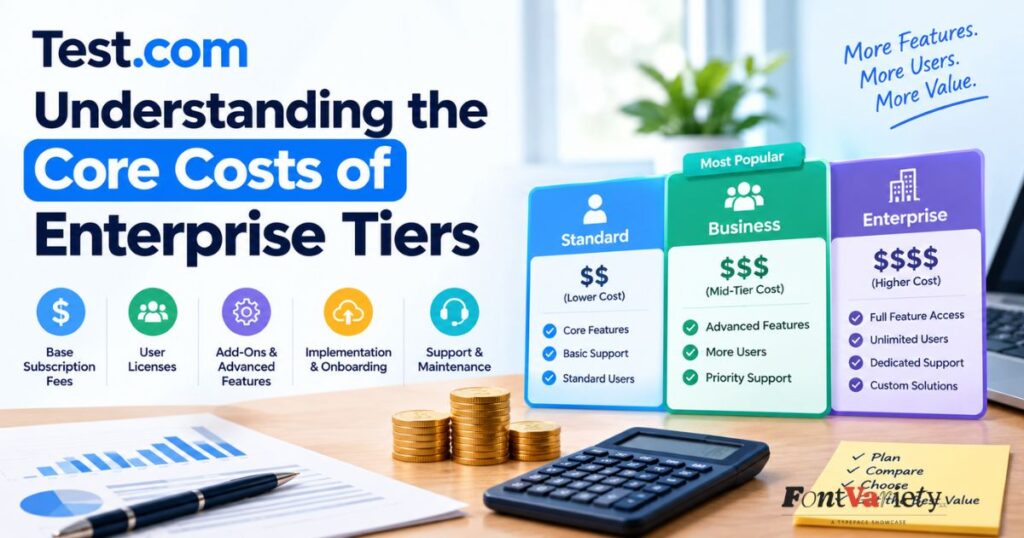
The core costs of any enterprise tier break down into licensing, usage, and support fees, with implementation costs layered on top in year one. Each of these categories can be negotiated somewhat independently, so it helps to request an itemized quote rather than a single bundled number.
Hidden costs sometimes appear in the form of mandatory add-ons, such as advanced security modules or extra API call allowances, that aren’t part of the base license. Reviewing the full quote line by line helps surface these before signing.
Currency, region, and payment terms can also affect the final cost, particularly for multinational organizations negotiating a single global contract. It’s worth confirming whether pricing is locked for the contract duration or subject to annual increases.
Key Features Included in Enterprise Packages
Enterprise packages generally include everything in the standard tier plus expanded administrative and integration capabilities. This typically means SSO, custom user roles, and deeper API access for connecting Test.com to internal HR or learning systems.
Advanced analytics is another common inclusion, offering deeper insight into candidate performance trends, question-level difficulty analysis, and custom report exports. These tools help larger organizations make data-driven decisions about their testing programs at scale.
Dedicated account management and priority support round out the typical package, ensuring faster response times for technical issues. For organizations running business-critical assessments, this support tier is often the deciding factor over standard plans.
Comparing Standard vs. Enterprise Value
Standard tiers make sense for smaller teams with predictable, low-volume testing needs and minimal integration requirements. They’re simpler to manage but lack the customization and support depth that larger organizations often require.
Enterprise tiers deliver more value as testing volume and organizational complexity grow, particularly when multiple departments or regions share one account. The higher cost is generally justified by reduced administrative overhead and better support responsiveness.
The right choice ultimately depends on projected growth, not just current needs. Organizations expecting rapid scaling often find it more cost-effective to negotiate an enterprise contract early rather than migrating later.
Managing Billing and Contractual Obligations
Enterprise contracts typically include minimum commitment clauses, renewal terms, and specific language around usage overages. Reviewing these terms carefully with your procurement or legal team helps avoid unexpected lock-in periods or penalty fees.
Billing cycles for enterprise accounts are often annual or quarterly rather than monthly, which requires more careful internal budgeting. It helps to align invoice timing with your organization’s fiscal planning cycles wherever possible.
Termination and downgrade clauses deserve particular attention, since exiting an enterprise contract early can carry significant penalties. Understanding these terms upfront protects your organization if business needs change mid-contract.
Integrating with Existing Enterprise Infrastructure
Most enterprise buyers evaluate Test.com based on how well it integrates with existing HR information systems, learning management systems, or applicant tracking software. API access and pre-built connectors can significantly reduce implementation time and cost.
Data synchronization between Test.com and internal systems needs to be tested thoroughly before full rollout, particularly around candidate records and score reporting. Misaligned data formats are a common source of post-launch friction.
IT and security teams should also review authentication and data-handling requirements early in the sales process. Confirming SSO compatibility and data residency options before signing avoids costly rework during implementation.
How Test.com Enterprise Plans Compare to Standard Tiers
The most obvious difference between tiers is customization: enterprise plans allow far more control over branding, permissions, and integrations than standard plans. Standard tiers are built for simplicity and quick setup, not deep configurability.
Pricing structure also diverges significantly, with standard tiers using flat, published rates while enterprise plans rely on negotiated, usage-sensitive contracts. This makes enterprise pricing less transparent upfront but potentially more cost-efficient at scale.
Support quality is another key differentiator, with enterprise customers typically receiving a named account manager and faster response times. For organizations where testing is mission-critical, this support gap alone can justify the price difference.
Getting Custom Quotes for Test.com Enterprise Solutions
Requesting a custom quote typically starts with a discovery call where Test.com’s sales team gathers details on your expected user count, test volume, and required integrations. Coming prepared with these numbers speeds up the process and leads to a more accurate initial quote.
It helps to request quotes broken down by component base license, per-test costs, onboarding, and add-ons—rather than accepting a single bundled figure. This transparency makes it easier to compare offers or negotiate specific line items later.
Many organizations also request a pilot or trial period before committing to a full enterprise contract. This lets internal stakeholders validate the platform’s fit before locking into a longer-term financial commitment.
Also Like To Read This: Tozymagazine.com Review 2026: A Complete Look at This Online Magazine
Negotiating Better Test.com Enterprise Pricing
Leverage comes primarily from volume commitments and contract length; offering a multi-year commitment or guaranteeing a higher test volume often unlocks better per-unit rates. Sales teams are typically more flexible on price when they can count on predictable, long-term revenue.
Timing matters too, since vendors are often more willing to negotiate near the end of their fiscal quarter or year. Aligning your procurement timeline with these periods can result in meaningful discounts or added-value concessions.
It’s also worth negotiating non-price terms, such as waived onboarding fees, extended trial periods, or included training sessions. These concessions can add substantial value even when the headline price doesn’t move much.
Test.com Enterprise Implementation and Onboarding
Implementation typically begins with a kickoff call to map out timelines, data migration needs, and integration requirements with your internal IT team. A clear project plan at this stage prevents delays once the technical work begins.
Data migration and system integration are usually the most time-consuming parts of onboarding, particularly when connecting to legacy HR or LMS platforms. Budgeting extra time for testing these integrations before go-live reduces the risk of disruptions.
Training for administrators and end users rounds out the onboarding process, often delivered through a mix of live sessions and self-service documentation. Investing time here upfront tends to reduce support tickets and improve adoption in the following months.
Maximizing ROI from Test.com Enterprise Plans
Getting strong ROI starts with using the full feature set you’re paying for, particularly advanced analytics and reporting tools that often go underutilized. Regularly reviewing these reports helps identify inefficiencies in your testing process that can be addressed directly.
Right-sizing your plan is equally important, since paying for unused seats or test allotments erodes value over time. Periodically auditing actual usage against your contracted amounts helps ensure you’re neither overpaying nor risking overage charges.
Finally, treating your account manager as a strategic resource rather than just a support contact can uncover additional value, from process optimization tips to early access to new features. Organizations that engage proactively with their vendor relationship tend to extract more value from the contract over time.
Test.com Enterprise Support and Customer Success
Enterprise accounts typically come with a dedicated customer success manager who checks in periodically to review usage, address issues, and identify optimization opportunities. This proactive support model differs significantly from the reactive, ticket-based support common in standard tiers.
Priority technical support usually includes faster response time guarantees, sometimes backed by formal service-level agreements (SLAs). For organizations running time-sensitive hiring or certification programs, these guarantees can be critical to maintaining business continuity.
Ongoing customer success efforts often include quarterly business reviews, where usage data and outcomes are discussed against organizational goals. These check-ins are a good opportunity to renegotiate terms or flag upcoming changes in testing volume before they affect billing.
Frequently Asked Questions
How much does Test.com’s enterprise plan cost?
Enterprise pricing typically starts around $10,000 annually for the base license, plus usage-based charges of roughly $3 per test beyond the included allotment. Actual costs vary based on user count, integrations, and negotiated contract terms.
Is Test.com enterprise pricing negotiable?
Yes. Contract length, committed test volume, and timing (such as end-of-quarter deals) can all influence the final rate. It’s common to negotiate discounts on per-test pricing or waived onboarding fees.
What’s the difference between Test.com’s standard and enterprise plans?
Enterprise plans add SSO, custom branding, advanced analytics, API access, and dedicated support—features generally unavailable or capped on standard tiers. Enterprise pricing is also custom-quoted rather than published.
Does the enterprise price include onboarding and implementation?
Not always. Onboarding, data migration, and integration setup are often billed as one-time fees in the first year, separate from the ongoing subscription cost. Confirm this with your account manager before signing.
What counts as a “test” for billing purposes?
Generally, one completed assessment session by one candidate counts as one test. Practice tests, retakes, and abandoned sessions may be treated differently depending on your contract, so it’s worth clarifying upfront.
Can I trial Test.com’s enterprise features before committing?
Many organizations negotiate a pilot period as part of the sales process, allowing internal stakeholders to validate the platform before signing a longer-term contract.
Conclusion
Test.com’s enterprise pricing is flexible by design, combining a base license with usage-based fees that scale alongside your organization’s testing needs. That flexibility is valuable, but it also means the final cost depends heavily on how well you understand your own usage patterns and negotiate your contract terms. Before signing, get an itemized quote, clarify exactly what counts as a billable test, and confirm which features and support levels are included in the base price versus billed as add-ons.
Ultimately, the enterprise tier tends to pay for itself for organizations running high testing volumes, managing multiple departments, or requiring the security and compliance features standard plans don’t offer. For smaller or lower-volume teams, it’s worth weighing that added cost against the standard tier’s simplicity before committing to a custom contract.